

What counts as a "head tilt" — and how common is it?
A head tilt is the sideways cocking of the head, rather than simply turning to look left or right. You may recognize it when your dog focuses on your face or an interesting sound: VCA describes a dog tilting toward a sound coming from the front, or turning before tilting when the sound comes from behind. A sound from the side may produce no tilt because the ears are already positioned to receive it. These examples show why the surrounding interaction matters; the same visible posture can occur while gathering information or, when held without an apparent communication-related trigger, as a possible medical sign.
How common is it? The supplied resources describe recognizable examples, but they do not provide a reliable percentage of dogs that tilt or a normal number of tilts per day. AKC reports a pilot study finding differences between dogs with pronounced muzzles and flatter faces, but that comparison is not a population-wide prevalence estimate. The more useful distinction in the medical passages is between occasional listening behavior and a sudden or persistent tilt. There is no supplied numerical cutoff that makes a posture harmless, and repeated tilting cannot be explained solely by comparing your dog with another dog that seems to do it more often.
References for this section: vcahospitals.com, akc.org, petmd.com.
Sensory reasons: hearing and vision
Hearing and vision offer different possible benefits from changing head position. The ears collect incoming sound, while the muzzle can interfere with the view of what is directly ahead; a tilt may help with either task. These explanations need not compete for a single answer. In AKC's behavior commentary, Jill Goldman suggests that vision, hearing and learning may all contribute and may work together, while emphasizing that more research is needed to separate their roles. For a dog watching an owner speak, both visual and sound information are available, so the movement alone does not establish which information the dog is trying to gather.
Ear shape provides a concrete example of the different sensory challenges dogs face. VCA explains that a German shepherd's ear flap covers the rear side of the ear canal and can interfere with sounds arriving from behind. A cocker spaniel's heavier flaps cover the canals more completely and interfere with transmission from multiple directions. Movable ear flaps and adjustments of head position can help compensate for that obstruction. These examples describe anatomy and the route sound takes into the ear, not measured differences in how often those breeds tilt. They therefore cannot supply a breed ranking or establish that a particular dog's tilt is caused by its ears.
References for this section: akc.org, vcahospitals.com.
How tilting helps your dog hear better
The visible ear flap is called the pinna, and dogs can move it to adjust sound collection. VCA describes those ear adjustments, together with head tilting, as ways to compensate for flaps that partly obstruct incoming sound. Another clue comes from comparing when a sound reaches the right and left ears: a sound arriving at one ear before the other provides information about its source. VCA links movable ear flaps and head orientation with assessing a sound's location and distance. In plain language, the explanation concerns positioning the ears to receive and compare sound, rather than assuming a tilted head simply turns up the volume.

Sound direction helps explain why the response is not identical every time. VCA notes that a dog may turn toward a sound behind it before tilting, whereas a sound coming from the side may require no tilt. That account does not establish that every head movement improves hearing, or that an unusual posture is an ordinary sound adjustment. Ear discomfort belongs to a separate explanation: VCA associates external ear infections with pain, itching and occasional tilting, and middle ear infections with a more persistent tilt. A head held sideways without an apparent sound-related interaction should therefore not be interpreted automatically as your dog listening especially hard.
References for this section: vcahospitals.com.
How tilting helps your dog see your face or a toy
A dog's muzzle projects into the view directly ahead, and a longer snout may obscure part of what the dog is looking at. VCA proposes that head tilting helps dogs work around this obstruction and see a person's face more clearly. Facial expressions contribute to communication, so a clearer view offers a possible benefit beyond locating the speaker's voice. This is a line-of-sight explanation, not a claim that the movement improves visual acuity or proves the dog understands a particular expression. The supplied passage focuses on viewing human faces; it does not establish a separate mechanism or measured benefit for tilting while looking at a toy.
AKC reports a pilot study by Coren in which dogs with more pronounced muzzles, including Greyhounds, tilted toward their owners more often than flatter-faced dogs. That observation makes muzzle shape worth investigating, but it does not demonstrate that obstruction caused each tilt. Goldman cautions in the same account that factors beyond snout length could be involved. VCA similarly suggests bulldogs and Boston terriers may tilt less because their shorter noses interfere less with the view. Both accounts support a possible anatomical influence, not a rule that every long-muzzled dog will tilt frequently or that a flat-faced dog has no reason to tilt at all.
References for this section: vcahospitals.com, akc.org.
Communication and cognition: attention, speech and learning
If you wonder why dogs tilt their heads when you talk, attention to meaningful sounds is another possibility. VCA reports a study in which dogs that successfully associated a word with a specific object were more likely to tilt when hearing that word. This is a secondary research summary: the supplied passage does not include the original paper, study methods or publication details. Its reported result suggests a relationship between word-object recognition and head tilting, rather than proving that the movement causes recognition. It also does not show that every tilting dog knows the spoken word, understands a complete sentence or has a particular level of intelligence.
In AKC's account, Goldman suggests that when an owner is directly in front of a dog, locating the voice may not be the goal. Instead, the dog may be gathering information from frequencies and vocal inflections, including the high-pitched voice people sometimes use during happy interactions. This is behavior commentary, not demonstrated causality or a way to read the dog's thoughts. Asking why dogs tilt their heads when confused already assumes an emotional explanation that these passages do not establish. Focusing on speech is a possible interpretation, but the visible movement cannot distinguish confusion from attention or confirm exactly what the dog understands about the exchange.
References for this section: vcahospitals.com, akc.org.
Could owner responses play a role?
Your response may become part of the picture. VCA describes people greeting a head tilt with pats, a kind voice and smiles, and proposes that positive responses can encourage repetition. AKC's Goldman likewise suggests that some dogs may tilt more often because rewarding events follow these interactions. These are source-attributed explanations of a possible learned influence, not controlled measurements of what happens after an owner smiles or offers praise. The supplied passages do not compare the effects of different responses or quantify any increase in tilting. They support discussing owner reactions as one possible contributor, while leaving the cause of an individual dog's behavior unresolved.
Goldman's examples include an owner asking about a cookie, walk or car ride, followed by the event the dog enjoys. That sequence offers a possible explanation for repetition during familiar exchanges, but the commentary cannot separate the influence of the words, vocal tone, attention and following activity. It does not demonstrate that a dog deliberately poses to look adorable, and it supplies no step-by-step method for increasing or reducing tilting. The same AKC passage also warns that a persistent tilt apparently unrelated to anything should prompt veterinary attention. A possible history of rewarding interactions is not enough to explain away a new, continuous or unexplained posture.
References for this section: vcahospitals.com, akc.org.
When a head tilt is a medical concern
A sudden or persistent head tilt can indicate an underlying health problem. PetMD explains that medical head tilts commonly involve the vestibular system, which helps control balance, posture, head position and eye movement. Its listed causes include ear infections, a ruptured eardrum, stroke, cancer and inflammation or infection of the brain, among other conditions. Sometimes no cause can be identified; PetMD calls this idiopathic vestibular disease and notes that it is most common in senior dogs. These are possible explanations to investigate, not diagnoses that can be selected from the direction of the tilt, the dog's age or the appearance of the posture alone.
An ear problem can produce tilting without being an ordinary listening response. VCA distinguishes painful, itchy external ear infections caused by bacteria or yeast from more serious middle ear infections often accompanied by a persistent tilt. Treatment depends on the underlying diagnosis: PetMD notes that some cases resolve on their own, while many need medication, supportive care or additional treatment. That does not provide a basis for choosing a home remedy from the posture. PetMD also lists certain ear washes and antibiotic use when an eardrum is ruptured among potential causes of tilting, reinforcing the importance of veterinary assessment rather than treating every case as the same ear problem.
References for this section: petmd.com, vcahospitals.com.
Signs to watch for and what your vet may ask
- Watch movement and balance. PetMD advises veterinary care right away when a head tilt accompanies avoiding standing or walking, stumbling, falling, poor coordination, circling or leaning. Leaning in the same direction as the tilt is also listed.
- Watch the eyes and stomach symptoms. Rapid side-to-side eye movements, called nystagmus, and vomiting alongside a head tilt are among PetMD's reasons to seek veterinary care immediately. These are accompanying warning signs, not proof of one particular disease.
- Watch alertness and hearing. PetMD also lists disorientation, confusion, fatigue or lethargy, and deafness or difficulty hearing as reasons for immediate care when they accompany a tilt. The combination deserves assessment rather than an assumption of ordinary curiosity.
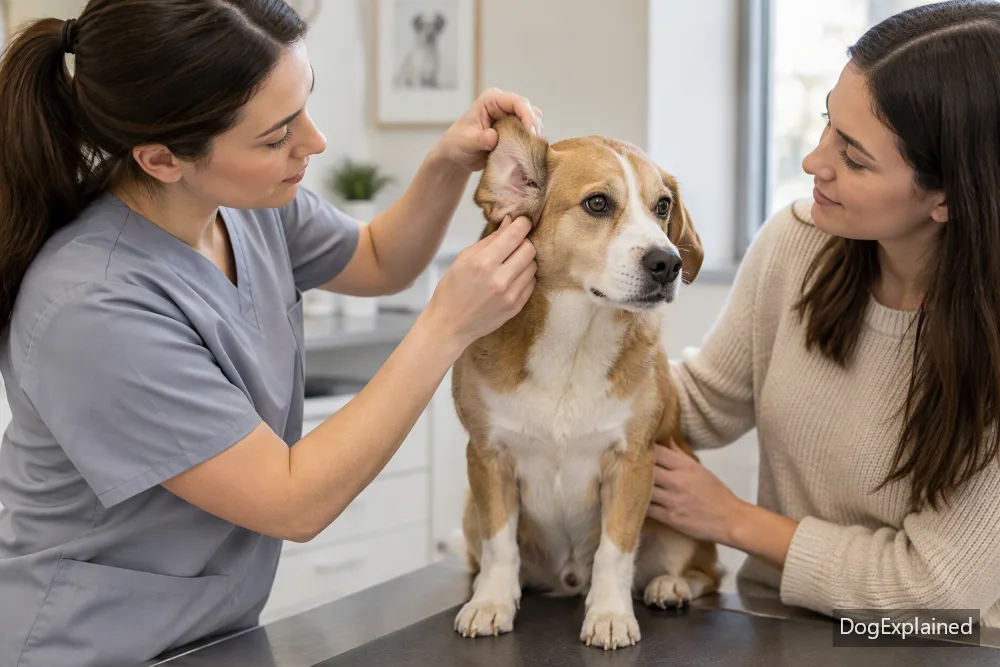
PetMD describes diagnosis beginning with a thorough physical examination, with particular attention to the ears. Additional testing depends on the suspected cause and may include blood work, urine testing, an electrolyte panel or assessment of nutritional status. Imaging such as X-rays, CT or MRI may be used to evaluate the middle ear. If brain inflammation or infection is suspected, testing of cerebrospinal fluid may be considered; a bone biopsy is another possibility when a bone tumor or infection is suspected. These are potential investigative steps, not a package every dog needs, and the supplied account does not prescribe a specific neurological examination protocol.
References for this section: petmd.com.
How owners can respond (everyday and urgent)
For everyday observation, the useful distinction is whether the tilt belongs to a brief interaction or is a posture your dog continues to hold. VCA identifies a consistent tilt unrelated to communication as a possible medical problem and recommends a veterinary visit when tilting occurs without auditory stimulation. PetMD similarly distinguishes curious or listening behavior from a persistent or sudden head tilt. These descriptions give you concrete features to notice: the connection to an interaction, whether the posture persists, and whether other symptoms accompany it. They do not supply a home test, a safe waiting period or a numerical frequency that rules out illness.
Contact a veterinarian for assessment of a sudden or persistent tilt, rather than deciding it must be a familiar listening habit. When the tilt comes with the warning signs above, PetMD advises immediate veterinary care: that includes balance problems, rapid eye movements, vomiting, disorientation, unusual lethargy or hearing difficulty. Its guidance does not require several warning signs to occur together before seeking help. The practical difference is between arranging evaluation for an unexplained posture and seeking care right away for a tilt with additional concerning symptoms. Because the cause determines treatment, the posture itself cannot tell you which medication or other treatment your dog needs.
References for this section: vcahospitals.com, petmd.com.
