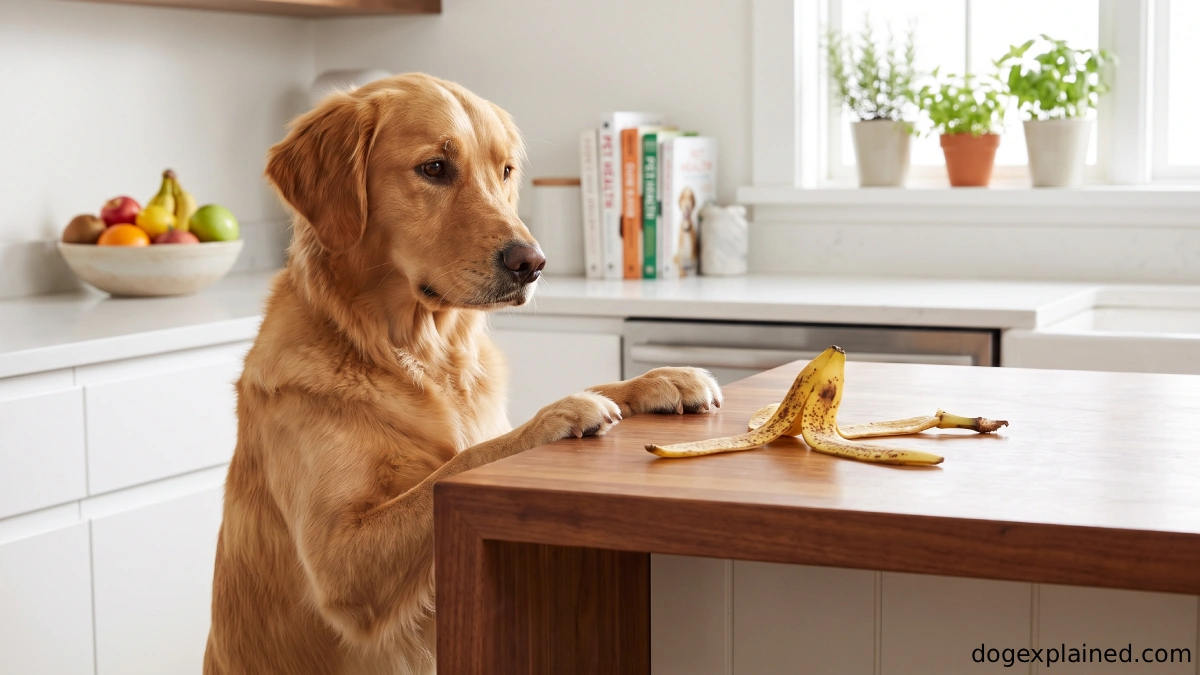
You leave a banana peel on the counter for a moment, turn around, and suddenly your dog is chewing it.
Or perhaps the peel is already gone.
Now the obvious question is: should you be worried?
Banana peels are not considered toxic to dogs, but that does not make them a safe thing to eat.
The main concern is not poisoning. It is the peel’s tough, fibrous texture. Banana peel can be difficult for a dog to digest, may cause gastrointestinal upset, and larger pieces can potentially become lodged in the digestive tract.
So if your dog ate banana peel, the important questions are how much was swallowed, how large the pieces were, how your dog is behaving now, and whether any concerning symptoms develop.
Can Dogs Eat Banana Peels?
No. Banana peels should not be intentionally fed to dogs.
The fruit inside a banana is generally considered safe for many dogs when offered appropriately, but the peel is a different matter.
Banana peel is:
- tough,
- fibrous,
- difficult to digest, and
- unnecessary as part of a dog’s diet.
A dog may chew and swallow pieces without an immediate problem, but that does not mean feeding peel is a good idea.
The biggest concern is that a sufficiently large or poorly chewed piece may behave like other non-digestible material in the gastrointestinal tract.
Some swallowed material passes through without incident.
Other material does not.
That uncertainty is why the safest approach is to remove the peel before offering banana to your dog.
Are Banana Peels Toxic to Dogs?
Banana peels are not considered toxic to dogs.
The ASPCA lists edible banana as non-toxic to dogs, and veterinary guidance from sources such as the American Kennel Club and PetMD also distinguishes banana peel from genuinely poisonous foods.
But there is an important difference between:
“Is this toxic?”
and:
“Is this safe for my dog to swallow?”
A substance can be non-toxic and still cause a physical problem.
A sock is not poisonous.
A piece of plastic is not necessarily poisonous.
But either can become dangerous if it blocks the gastrointestinal tract.
Banana peel presents a similar type of concern on a smaller scale: the problem is primarily digestibility and the possibility that tough material may fail to pass normally.
So describing banana peels as “non-toxic” should never be interpreted as permission to feed them.
Why Banana Peels Can Be a Problem for Dogs
There are several reasons veterinarians and pet-health organizations recommend removing the peel.
1. Banana Peel Is Difficult to Digest
Dogs can digest many foods efficiently, but not every type of plant material breaks down easily.
Banana peel has a tough, fibrous structure compared with the soft fruit inside.
That matters because the digestive tract has to move whatever your dog swallows from the stomach through the intestines.
A small, well-chewed piece may pass.
A larger, thicker piece may be more difficult to process.
There is no reliable household test that can tell you in advance exactly what a particular piece will do once swallowed.
2. It May Cause Gastrointestinal Upset
Even when peel does not become lodged, eating something unusual can irritate a dog’s digestive system.
Depending on the dog and the amount eaten, gastrointestinal signs could include:
- vomiting,
- diarrhea,
- reduced appetite,
- abdominal discomfort, or
- general restlessness.
A brief mild stomach upset and an intestinal obstruction are not the same thing.
However, when a dog has swallowed something difficult to digest, persistent or worsening digestive symptoms deserve more attention.
3. A Larger Piece Can Behave Like a Foreign Body
Veterinary medicine uses the term “foreign body” for material that a pet swallows but cannot readily digest or pass.
Common examples include:
- toys,
- pieces of clothing,
- bones,
- wrappers,
- sticks,
- rocks, and
- other non-digestible material.
Banana peel is softer than many of those objects, but a large piece can still be difficult to move through the gastrointestinal tract.
A foreign body may cause:
- no problem at all,
- a partial obstruction, or
- a complete obstruction.
The outcome depends on several factors, including the size and characteristics of what was swallowed and where it travels in the gastrointestinal tract.
My Dog Ate a Banana Peel — What Should I Do?
If your dog has already swallowed banana peel, try not to jump immediately to the worst-case scenario.

A small piece and an entire peel are not identical situations.
Use the following steps to assess what happened.
Step 1: Work Out What Your Dog Ate
Try to determine:
- Was it one small piece?
- Was it a large strip?
- Was most or all of a peel eaten?
- Was the peel chewed into pieces?
- Was a large section swallowed whole?
- Is any peel still missing?
- Is your dog acting normally?
You do not need to calculate an exact gram amount.
Simply give your veterinarian the best description you can if you need advice.
Step 2: Remove Any Remaining Peel
Move the remaining banana, peel, trash, or food waste out of reach.
This prevents your dog from turning a small ingestion into a much larger one while you are deciding what to do.
Step 3: Check How Your Dog Is Acting
Look at the whole dog rather than focusing only on the fact that peel was eaten.
Is your dog:
- alert?
- comfortable?
- breathing normally?
- interested in normal activities?
- vomiting?
- showing abdominal discomfort?
- unusually quiet?
- refusing food?
A dog behaving completely normally after swallowing a tiny piece presents a different situation from a dog repeatedly vomiting after swallowing a large strip.
Step 4: Contact Your Veterinarian When Appropriate
Contact your veterinarian if:
- a large amount may have been swallowed,
- a large piece was swallowed whole,
- you cannot tell how much was eaten,
- your dog is very young or otherwise medically vulnerable,
- symptoms develop, or
- you are unsure whether home observation is appropriate.
Your veterinarian can evaluate the circumstances for your individual dog instead of relying on a generic internet rule.
What Happens If a Dog Eats a Banana Peel?
There is more than one possible outcome.
The Peel May Pass Without a Problem
Some foreign material moves through a dog’s gastrointestinal tract and eventually passes without causing illness.
That is possible with banana peel too.
But “possible” does not mean “guaranteed.”
Your Dog May Develop Digestive Upset
Some dogs may experience vomiting, diarrhea, reduced appetite, or discomfort after eating peel.
This may occur even without a blockage.
The Peel May Become Lodged
The more serious concern is that material fails to pass normally and creates a partial or complete obstruction.
Veterinary sources on gastrointestinal foreign bodies consistently emphasize that some swallowed objects pass while others become lodged.
That is why nobody can responsibly promise from an online article that a swallowed peel will definitely pass.
Signs of a Possible Intestinal Blockage
If your dog has swallowed banana peel or another difficult-to-digest object, watch for changes such as:
- vomiting,
- repeated vomiting,
- loss of appetite,
- abdominal pain or tenderness,
- lethargy,
- weakness,
- diarrhea,
- straining to defecate,
- passing only small amounts of stool,
- dehydration, or
- noticeable behavioral changes caused by discomfort.
These signs are not unique to intestinal obstruction.

A dog can vomit or lose appetite for many reasons.
But when these symptoms occur after a possible foreign-body ingestion, they are important information for your veterinarian.
An unresolved gastrointestinal obstruction can become serious because it may interfere with normal intestinal movement, hydration, blood supply, and tissue health.
When Should You Call a Vet?
You do not necessarily need to assume that every dog that touches a tiny piece of banana peel has a medical emergency.
But veterinary guidance becomes more important when the ingestion or symptoms are more concerning.
Contact your veterinarian promptly if:
- your dog swallowed most or all of a banana peel,
- a large piece appears to have been swallowed intact,
- the amount swallowed is unknown,
- your dog begins vomiting,
- your dog stops wanting food,
- your dog appears painful,
- your dog becomes unusually lethargic,
- your dog strains to pass stool,
- your dog seems unable to get comfortable, or
- symptoms are persistent or worsening.
Seek urgent veterinary care if your dog appears severely unwell, collapses, becomes markedly weak, has repeated vomiting, develops severe abdominal pain, or has another significant acute change.
The safest decision depends on the dog and the situation rather than an arbitrary number of hours.
Should I Make My Dog Vomit After Eating a Banana Peel?
Do not induce vomiting unless a veterinarian or qualified poison professional specifically advises you to.
Making a dog vomit is not automatically safe simply because something unwanted was swallowed.
Whether vomiting should be induced depends on factors such as:
- what was swallowed,
- when it happened,
- the dog’s health,
- the dog’s ability to protect their airway, and
- whether bringing the material back up could create additional risk.
Home methods recommended casually online can cause harm.
Do not use:
- salt,
- mustard,
- cooking oil,
- fingers down the throat, or
- other improvised methods.
If you believe your dog swallowed something potentially harmful and you are unsure what to do, contact your veterinarian or an appropriate animal poison-control service for individualized guidance.
Can a Dog Pass a Banana Peel Naturally?
Yes, some dogs may pass swallowed banana peel without complications.
Veterinary guidance on gastrointestinal foreign bodies makes clear that some swallowed material moves through the intestinal tract uneventfully.
But not every foreign body passes.
Whether something passes can depend on:
- the size of the swallowed piece,
- its shape and texture,
- where it is in the gastrointestinal tract, and
- the individual dog.
That means nobody looking at the situation remotely can guarantee:
“Your dog will poop it out.”
A better way to think about it is:
Passage is possible. Guaranteed passage is not.
If your veterinarian thinks observation is appropriate, follow their instructions about what signs to watch for and when your dog should be re-evaluated.
Can Puppies Eat Banana Peels?
No. Puppies should not be intentionally given banana peels.
Puppies are curious and often explore objects with their mouths, which means accidental ingestion is certainly possible.
If a puppy swallows a piece of peel, the same concerns apply:
- poor digestibility,
- digestive upset, and
- possible foreign-body obstruction.
Because a puppy is smaller and still developing, it is reasonable to contact your veterinarian when you are uncertain about the amount swallowed or whether the ingestion is significant.
Do not use an adult dog’s previous experience with banana peel as proof that a puppy will have the same outcome.
Banana Flesh vs Banana Peel
It helps to separate the two parts of the fruit.
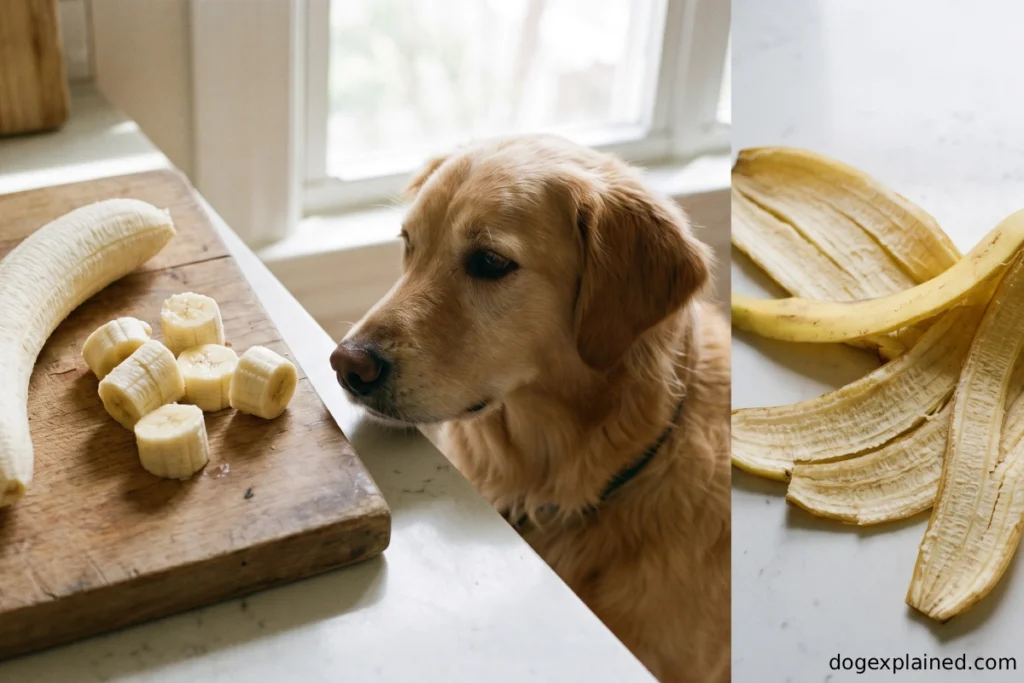
Banana Flesh
The soft fruit inside a banana can generally be offered to many dogs as an occasional treat.
Bananas contain carbohydrates, fiber, potassium, and several vitamins, but they also contain natural sugar.
That means portion size still matters.
If you want to learn more about offering the actual fruit, see our guide to can dogs eat bananas.
Banana Peel
The peel does not offer a practical benefit that justifies the digestive risk.
It is:
- harder to chew,
- harder to digest, and
- more likely than the soft fruit to create a foreign-body concern.
So even though the peel is not considered toxic, remove it before giving banana to your dog.
Are Banana Peels Bad for Dogs?
They can be.
The word “bad” can mean several things, so it helps to be precise.
Banana peels are not considered poisonous.
But they can still be inappropriate for dogs because they may:
- be difficult to digest,
- cause stomach upset, and
- contribute to an intestinal blockage if a problematic piece is swallowed.
That is enough reason not to feed them intentionally.
You do not need a food to contain a toxin before deciding that it should stay out of your dog’s bowl.
Are Banana Peels Poisonous to Dogs?
No, banana peels are not generally classified as poisonous to dogs.
This is one reason owners can become confused after reading different answers online.
One page may say:
“Banana peels are not toxic.”
Another may say:
“Do not let dogs eat banana peels.”
Both statements can be true.
The first statement describes toxicity.
The second describes practical safety.
A non-toxic object can still cause gastrointestinal problems when swallowed.
That distinction is more useful than simply labeling the peel “safe” or “dangerous.”
What If My Dog Ate Only a Small Piece of Banana Peel?
A small piece may pass through without causing a problem.
That does not mean it is possible to guarantee the outcome.
If your dog ate only a small amount and remains completely normal, your veterinarian may advise observation depending on the circumstances.
Watch for changes such as:
- vomiting,
- reduced appetite,
- abdominal discomfort,
- lethargy,
- diarrhea, or
- difficulty passing stool.
If symptoms develop, contact your veterinarian.
If you are uncertain whether the piece was actually small or how much your dog swallowed, calling your vet for guidance is reasonable.
What If My Dog Ate a Whole Banana Peel?
A whole peel is more concerning than a tiny piece because it represents a much larger amount of tough material.
If your dog swallowed an entire or nearly entire peel, contact your veterinarian rather than assuming it will pass.
Provide whatever information you have, including:
- your dog’s approximate size,
- when the ingestion happened,
- whether the peel was chewed,
- whether it was swallowed in large pieces, and
- whether your dog currently has any symptoms.
Your veterinarian can decide whether observation, examination, imaging, or another approach is appropriate.
How Long Does It Take a Dog to Pass Banana Peel?
There is no responsible one-size-fits-all answer.
Gastrointestinal transit time varies among dogs and depends on multiple factors.
More importantly, if material becomes lodged, normal passage may not occur at all.
For that reason, we do not recommend relying on an internet countdown such as:
“If you don’t see it in the stool within exactly X hours, something is wrong.”
Instead, follow your veterinarian’s advice and pay attention to your dog’s overall condition.
Symptoms matter more than an arbitrary timer.
Can Banana Peel Cause an Intestinal Blockage?
Yes, it potentially can.
Veterinary guidance specifically warns that banana peels are difficult to digest and that larger pieces can contribute to an intestinal blockage.
An obstruction occurs when material cannot move normally through part of the gastrointestinal tract.
Obstructions can be:
- partial, or
- complete.
The seriousness depends on factors such as where the obstruction occurs, how long it remains, and how much normal intestinal function is affected.
This is why repeated vomiting, abdominal pain, loss of appetite, or significant lethargy after swallowing difficult-to-digest material should not be ignored.
How Can I Prevent My Dog From Eating Banana Peels Again?
For many dogs, prevention is mostly about managing access.
Try to:
- place peels directly into a secured trash bin,
- keep fruit waste off counters your dog can reach,
- avoid leaving compost containers accessible,
- teach and reinforce a reliable “leave it” cue,
- avoid chasing your dog if they grab food waste and tend to swallow when pursued, and
- trade inappropriate objects for something safe when appropriate.
If your dog frequently eats non-food objects or repeatedly seeks out items that could be dangerous, discuss the behavior with your veterinarian.
Repeated ingestion of inappropriate objects deserves more attention than one opportunistic banana-peel theft.
Frequently Asked Questions
Can dogs eat banana peel?
Dogs should not intentionally eat banana peel. It is not considered toxic, but it is difficult to digest and may cause stomach upset or an intestinal blockage.
Are banana peels toxic to dogs?
Banana peels are not considered toxic to dogs. The main concern is that the tough peel can be difficult to digest and may act as a gastrointestinal foreign body.
My dog ate a banana peel. Should I panic?
Not necessarily. The level of concern depends on how much was swallowed, the size of the pieces, your dog’s condition, and whether symptoms develop. Contact your veterinarian if a large amount was swallowed or you are uncertain about the risk.
What if my dog ate a small piece of banana peel?
A small piece may pass without a problem, but monitor your dog. Contact your veterinarian if vomiting, loss of appetite, abdominal discomfort, lethargy, or difficulty passing stool develops.
What if my dog ate an entire banana peel?
Contact your veterinarian for individualized guidance. An entire peel represents more difficult-to-digest material than a small piece and deserves more caution.
Can banana peel cause a blockage?
Yes. Tough foreign material that does not pass through the gastrointestinal tract can potentially cause a partial or complete obstruction.
Should I induce vomiting if my dog ate banana peel?
Do not induce vomiting unless a veterinarian or qualified poison professional specifically directs you to do so.
Can a dog pass banana peel naturally?
Some dogs may pass banana peel without complications, but passage cannot be guaranteed. Monitor according to veterinary advice and watch for symptoms.
Can puppies eat banana peels?
No. Puppies should not intentionally eat banana peel. If a puppy swallows a significant amount or you are unsure about the ingestion, contact your veterinarian.
Are banana skins safe for dogs?
Banana skin and banana peel mean the same thing in this context. Neither should be intentionally fed to dogs.
The Bottom Line
Banana peels are not considered toxic to dogs, but they are not a safe or useful treat.
Their tough, fibrous texture can be difficult to digest. A dog that swallows banana peel may experience no problem, temporary gastrointestinal upset, or, in some cases, a foreign-body obstruction.
If your dog ate banana peel, consider how much was swallowed, whether the peel was chewed into small pieces, and how your dog is behaving.
Do not induce vomiting or use home remedies unless a veterinarian or qualified poison professional specifically advises you to do so.
Contact your veterinarian if your dog swallowed a large amount or large intact piece, if you are unsure how much was eaten, or if your dog develops vomiting, loss of appetite, abdominal pain, lethargy, difficulty passing stool, or another concerning change.
The most important distinction is this:
Banana peel is not considered poisonous, but that does not make it safe to swallow.