If your dog seems determined to cover your hands, face, or feet in kisses, there probably is not one single explanation.
Dogs use licking for several purposes, and the meaning can change from one moment to the next. A dog that gives you two relaxed licks when you come home may be doing something very different from a dog that repeatedly licks during an uncomfortable interaction.
Instead of asking only, “Why is my dog licking me?” look at what happened immediately before the licking, what your dog’s body looks like while doing it, and what happens afterward.
Here are eight common explanations.
1. Your Dog May Be Showing Affection and Familiarity
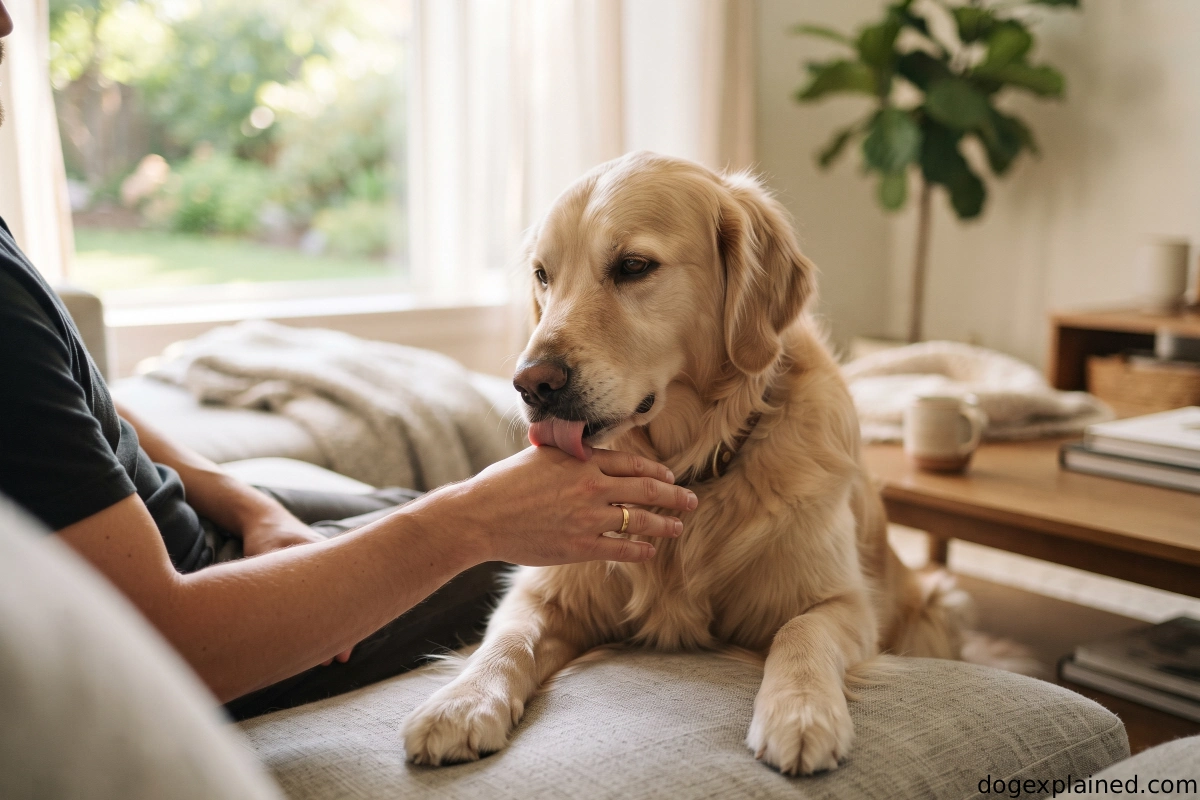
Sometimes the simple explanation is reasonable: your dog enjoys being close to you.
Licking is part of dogs’ social behavior from an early age, and some dogs continue using it during friendly interactions with people they know well.
Affection-related licking is more convincing when the rest of the dog looks relaxed.
You might notice:
- a loose body
- soft facial muscles
- relaxed ears
- normal breathing
- a gently wagging body or tail
- willingness to settle afterward
That does not mean every lick is the canine equivalent of a kiss. Licking can have several meanings, so body language and context matter more than the behavior by itself.
2. Licking Gets Your Attention
Dogs are very good at discovering what makes humans respond.
Imagine your dog licks your hand while you are working. You look down, say the dog’s name, scratch behind the ears, or push the nose away.
From the dog’s perspective, something happened.
Even a response you intended as “stop” may still provide eye contact, touch, or conversation.
If licking reliably starts an interaction, your dog may repeat it because the behavior works.
This is especially likely when licking appears while you are:
- using your phone
- working at a desk
- watching television
- talking to another person
- preparing to leave
- sitting somewhere your dog expects attention
The pattern can gradually become a learned habit without anyone deliberately teaching it.
3. You Smell or Taste Interesting
Sometimes your dog is less interested in romance and more interested in what is on your skin.
Hands can carry traces of food and scents from everything you have touched. Faces may smell interesting after a meal. Feet and legs can carry sweat and environmental odors.
Human skin can also taste slightly salty after exercise or during hot weather.
That helps explain why a dog might suddenly become fascinated with you after you:
- finish eating
- cook a meal
- return from exercise
- apply a scented product
- come home after visiting another animal
- handle something with a strong smell
If the licking occurs mainly in situations like these, sensory investigation may explain more than affection does.
4. Licking Can Be Part of a Social Greeting
Some dogs include licking in their greeting routine.
You walk through the door, your dog approaches with a loose body, perhaps brings a toy, moves close to you, and gives a few licks before settling down.
That is different from persistent licking that continues regardless of what is happening around the dog.
Social licking has roots in canine communication and can occur alongside other friendly greeting behaviors.
Over time, your own response can strengthen the ritual.
If every homecoming ends with petting and excited conversation after your dog licks you, the entire sequence can become part of how the two of you greet each other.
5. Your Dog May Be Excited or Overstimulated
Licking can also appear when a dog has a lot of emotional energy and is not quite sure what to do with it.
For example, some dogs lick intensely when:
- visitors arrive
- someone returns home
- play becomes exciting
- the leash comes out
- they anticipate food
- several people are interacting with them at once
Look at the whole dog.
Excited licking may occur alongside rapid movement, jumping, pacing, vocalizing, difficulty settling, or repeatedly moving between people.
In this situation, the licking may be one part of a larger high-arousal response rather than a deliberate request for affection.
Helping the dog settle may reduce the licking naturally.
6. Sometimes Licking Means “I’m Not Completely Comfortable”
This is one reason not to automatically translate every lick as “I love you.”
Dogs can use licking during uncertain or socially uncomfortable situations.
A dog may lick while also:
- turning the head away
- leaning away
- lowering the body
- holding the ears back
- showing a tucked or lowered tail
- repeatedly looking away
- trying to create distance
- appearing tense rather than loose
The individual signals need to be interpreted together rather than in isolation.
For example, a dog that approaches voluntarily with a loose body and gives you a lick is presenting a very different picture from a dog being hugged tightly while turning away and repeatedly licking.
If the dog looks uncomfortable, give them space rather than assuming they want more physical contact.
7. Licking Can Become a Self-Soothing Habit
Licking can be rewarding and calming for some dogs.
A dog may therefore lick more during periods of:
- stress
- frustration
- boredom
- uncertainty
- changes in routine
- insufficient enrichment
Occasional self-soothing behavior is not automatically a problem.
The concern is the pattern.
Ask yourself:
- Can my dog easily stop?
- Does licking interfere with resting or playing?
- Does it happen mainly during stressful situations?
- Has the frequency increased noticeably?
- Does my dog seem unable to settle without doing it?
A behavior can begin for an ordinary reason and become repetitive because the act itself is rewarding.
8. Excessive Licking Can Sometimes Signal a Problem
The word “excessive” matters more than simply counting licks.
One dog may naturally be more physically expressive than another.
More concerning patterns include licking that:
- begins suddenly without an obvious explanation
- becomes much more frequent than usual
- is difficult to interrupt
- interferes with sleep, play, eating, or normal activity
- occurs alongside obvious anxiety or distress
- accompanies vomiting or other digestive changes
- occurs along with scratching, redness, or skin irritation
- is associated with pain or other unusual behavior
- extends to constant licking of floors, furniture, or the dog’s own body
Medical and behavioral causes can overlap.
If the behavior has changed substantially, a veterinarian is a sensible first stop. Once medical causes have been considered, a qualified behavior professional can help if the pattern appears primarily behavioral.
What Does Your Dog’s Body Language Tell You?
The licking itself gives you only part of the answer.
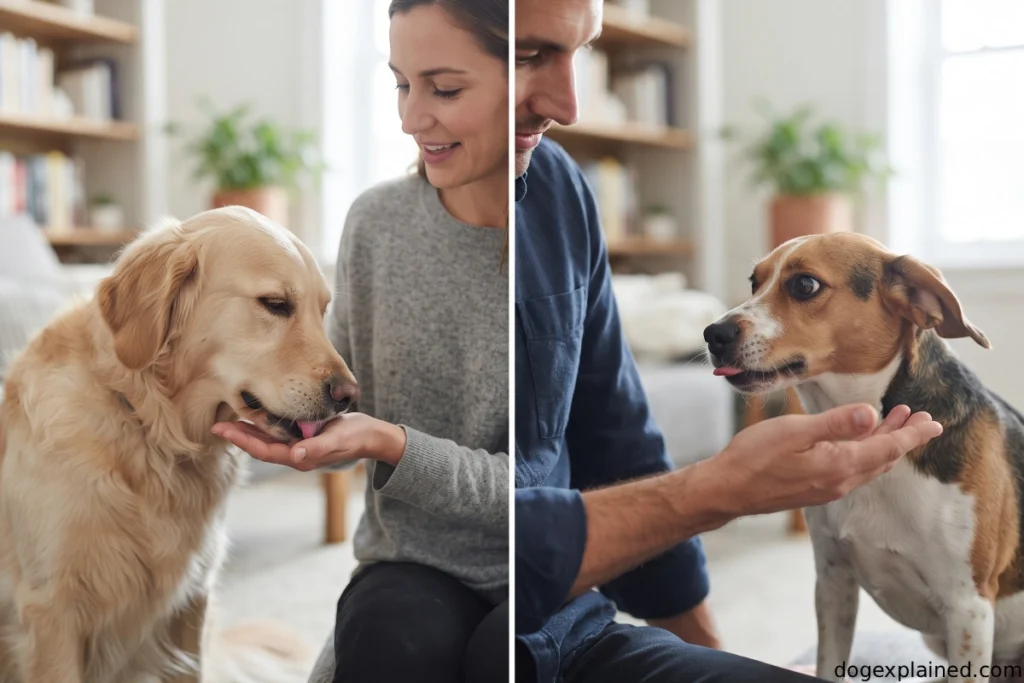
Compare these two situations.
A dog walks toward you by choice, has a loose body, gently licks your hand, receives a scratch, and lies down nearby.
Now consider a dog that is being held closely, keeps turning the head away, has tense facial muscles, repeatedly licks, and tries to move away.
Both dogs are licking.
The emotional context is very different.
Rather than interpreting one behavior in isolation, notice:
- body tension
- ear position
- tail and overall body movement
- whether the dog approaches or tries to leave
- facial expression
- what happened immediately before the licking
- whether the dog settles when the interaction ends
This approach is more useful than relying on a rule such as “licking always means affection.”
Why Does My Dog Lick Me More Than Everyone Else?
Being licked more than another person does not necessarily mean you have won a household popularity contest.
Your dog may lick you more because:
- you respond to licking more consistently
- you spend more time interacting with the dog
- your daily routine creates more opportunities for it
- your skin, hands, or clothing carry interesting scents
- licking has become part of the way you greet each other
- the dog has learned that you are the person most likely to respond
Several of these explanations can be true at the same time.
Look for patterns before assigning an emotional meaning.
Why Does My Dog Lick My Hands, Face, Legs, or Feet?
The location can sometimes offer another clue.
Hands
Your hands collect smells from food, other animals, objects, and places throughout the day.
They are also the body part you commonly use to pet, feed, and interact with your dog.
That makes hands particularly interesting.
Face
Face licking may occur during greeting or social interaction, but your face can also carry food smells and other interesting scents.
If you do not want your dog licking your face, you do not need to allow it simply because the behavior is normal.
Legs and Feet
Sweat, salt, soaps, lotions, and environmental odors can make legs and feet interesting to a dog’s nose and tongue.
A dog that becomes especially enthusiastic after you exercise may simply be investigating what smells and tastes different.
Should You Let Your Dog Lick You?
You can set boundaries around licking.
A normal canine behavior does not have to be a behavior you personally enjoy.
From a hygiene perspective, avoid allowing dogs to lick open wounds or broken skin. Extra caution is also appropriate around the mouth and face and for people at higher risk of infection.
If you prefer not to be licked, teach an alternative rather than repeatedly allowing the behavior until you become frustrated.
Consistency makes the lesson easier for the dog to understand.
How to Reduce Excessive Licking Without Punishment
If your veterinarian has no medical concerns and the licking is primarily behavioral, first work out what the dog receives from it.
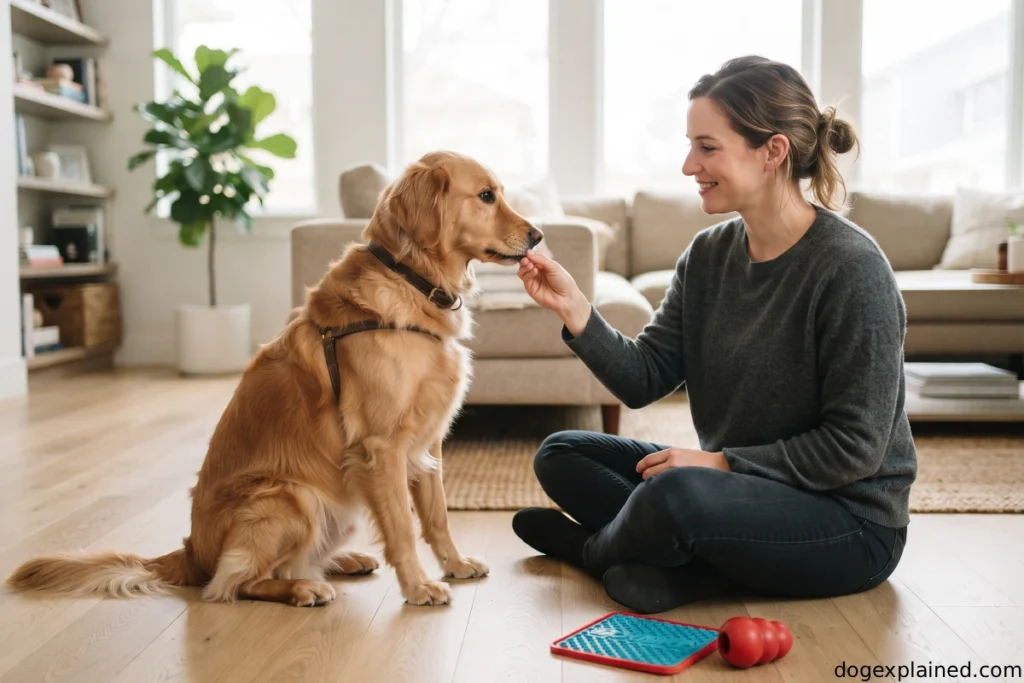
Identify the trigger
Notice when licking happens.
Is it when you sit down? When you return home? When the dog is bored? When visitors arrive?
A simple pattern is easier to change than a behavior treated as random.
Stop accidentally rewarding it
If licking is being used to get attention, avoid turning every lick into a conversation, wrestling match, or petting session.
Calmly change the interaction.
Reinforce an alternative
Ask for something your dog already knows, such as:
- sit
- lie down
- go to a mat
- bring a toy
Reward the alternative behavior you want to see more often.
Provide an appropriate outlet
Exercise, sniffing opportunities, food puzzles, training, play, and other enrichment may help when licking increases because the dog is bored or over-aroused.
Avoid punishment
Shouting or physical correction can add stress and may still provide the attention the dog was seeking.
Clear redirection and reinforcement of an alternative behavior are usually more useful.
When to Talk to a Vet or Behavior Professional
Arrange a veterinary check if your dog’s licking suddenly changes or becomes persistent, difficult to interrupt, or associated with other symptoms.
Pay particular attention to:
- pain
- itching
- skin problems
- vomiting or digestive changes
- loss of appetite
- unusual lethargy
- repeated licking of one body area
- significant anxiety or behavior change
If medical causes are ruled out but the licking remains disruptive or appears closely tied to fear, anxiety, or compulsive behavior, ask your veterinarian about an appropriately qualified behavior professional.
Frequently Asked Questions
Does My Dog Lick Me Because They Love Me?
Possibly.
Affection and social bonding can contribute to licking, but they are not the only explanations. Dogs also lick to seek attention, investigate tastes and smells, communicate, greet, and sometimes cope with excitement or stress.
Use the surrounding context instead of assuming every lick means the same thing.
Why Does My Dog Lick Me When I Pet Them?
The interaction itself may be social and enjoyable, or your dog may have learned that licking keeps your attention going.
Check the dog’s body language. A relaxed dog choosing to remain near you is different from a tense dog licking while trying to turn or move away.
Why Does My Dog Lick Me Before Bed?
For some dogs, licking becomes part of a predictable settling routine.
It may be associated with social contact, attention, or self-soothing.
A bedtime pattern is less concerning when the dog is relaxed and can easily stop than when the behavior becomes repetitive or difficult to interrupt.
Why Does My Dog Suddenly Lick Me More Than Usual?
First consider what has changed.
There may be a new routine, different scents, more opportunities for attention, increased excitement, or stress.
A sudden unexplained increase is also worth discussing with a veterinarian if it persists or occurs alongside physical or behavioral changes.
Why Does My Dog Lick Me After I Shower?
Your skin may smell and taste different after a shower because of water, soap, skin products, and changes in the scents your dog normally associates with you.
Dogs often investigate changes in their environment using both smell and taste.
Most dog licking is easier to understand when you stop treating the lick itself as the entire message. Look at when it happens, what your dog looks like, what the dog gains from doing it, and whether the pattern has changed. Those clues usually tell you far more than the number of kisses you receive.