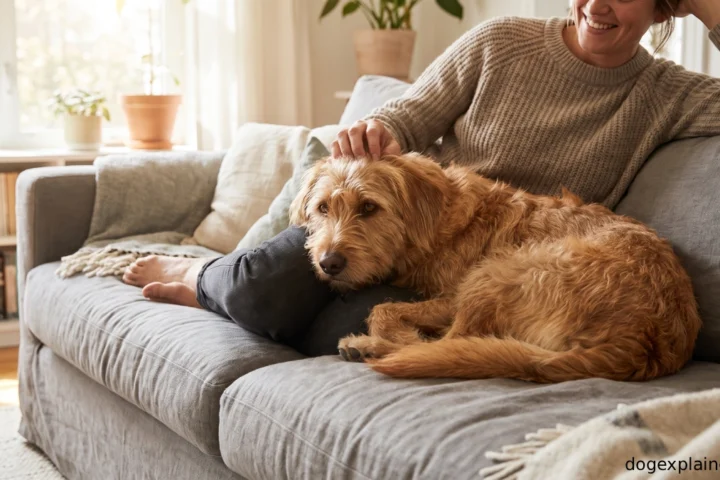
You sit down at your desk, and your dog immediately lowers themselves across your feet.
You move to the couch. A few minutes later, there they are again—sitting directly on your toes even though there is plenty of empty floor nearby.
For some dogs, their owner’s feet seem to be premium real estate.
So why does your dog lay or sit on your feet instead of simply resting beside you?
Usually, the explanation is much less dramatic than internet myths suggest. Your dog may want physical closeness, enjoy the spot, have developed a familiar routine, or have learned that touching you brings attention. In some situations, staying close may also provide reassurance.
What the behavior does not automatically mean is that your dog is trying to dominate you, claim ownership of you, or act as your personal bodyguard.
The most useful clue is not simply where your dog sits. It is what is happening around the behavior.
Why Does My Dog Lay or Sit on My Feet?
First, it helps to separate a few similar behaviors.
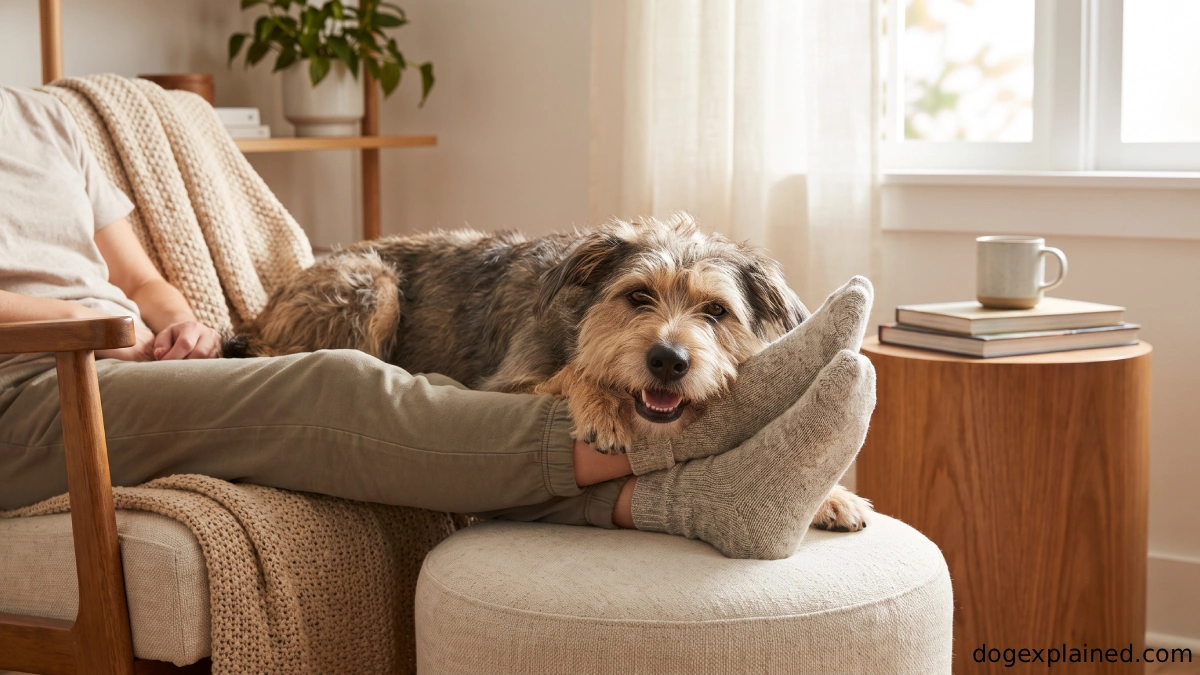
A dog lying directly ON your feet is making physical contact with you.
A dog lying AT your feet may simply be resting nearby.
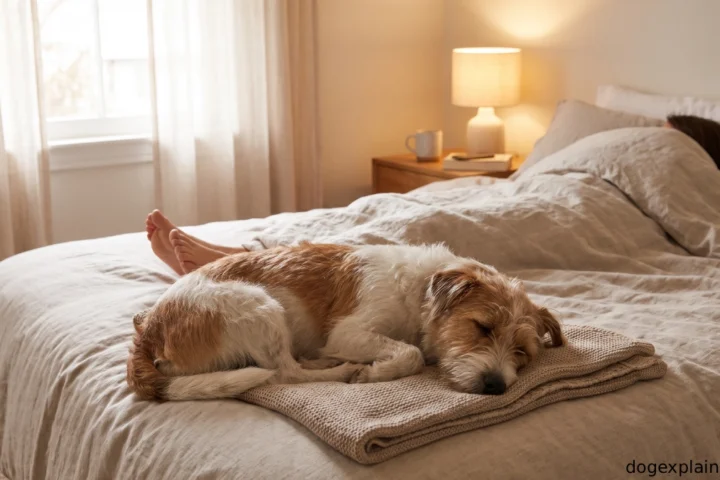
And a dog that regularly SLEEPS at the foot of your bed or near your feet may be showing a broader sleeping-position preference.
Those behaviors overlap, but they aren’t necessarily identical.
This article focuses mainly on dogs that deliberately sit, lie, or settle directly on their owner’s feet.
Dogs can form strong social relationships with their caregivers. Research into dog-human attachment has found evidence of owner-specific proximity and what researchers call a “secure base effect”—meaning a familiar owner can influence how a dog behaves in challenging or unfamiliar situations.
That makes closeness to you meaningful.
But the research does not establish a rule saying:
“Dog sits on feet = love.”
Or:
“Dog sits on feet = protection.”
The position itself doesn’t have one universal translation.
Two dogs can sit on their owners’ feet for completely different reasons.
1. Your Dog Wants to Be Close to You
This is often the simplest explanation.
Your dog likes being near you.
If you’re sitting in a chair, working at a desk, cooking nearby, or relaxing on the couch, your feet may be the easiest part of you for your dog to reach without climbing into your lap.
Dogs can seek proximity to familiar caregivers, and research supports the existence of meaningful attachment relationships between dogs and their owners.
But it is better to interpret the whole pattern than one isolated behavior.
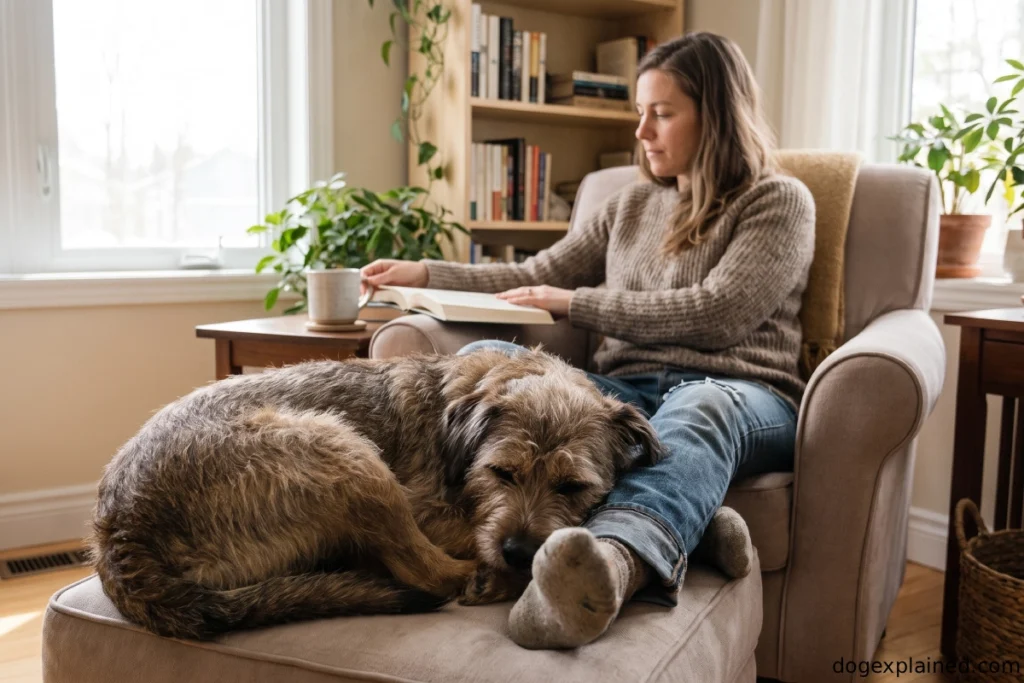
For example, does your dog also:
- choose to rest near you?
- approach you willingly?
- relax comfortably in your presence?
- follow you into shared spaces?
- seek you out in unfamiliar situations?
- enjoy normal interaction with you?
If so, sitting on your feet may simply be one part of your dog’s preferred way of being close.
It does not need a more complicated explanation.
Sometimes your dog wants to be near you, and your feet happen to be where “near you” ends.
2. Your Feet Are a Convenient Resting Spot
From your dog’s perspective, the location may simply work.
Imagine where your feet are during an ordinary day.
They may be:
- underneath your desk
- beside the couch
- under the dining table
- next to your favorite chair
- close to the kitchen counter
- wherever you sit for long periods
Those are also places where your dog can settle without being stepped around by everyone else in the room.
For a small or medium-sized dog, your feet may even provide a slight physical boundary to lean against.
Some dogs seem to enjoy resting with part of their body touching something—a wall, furniture, another dog, or a person.
Your feet may therefore combine two useful things:
a convenient resting place and direct physical contact.
There doesn’t have to be a hidden psychological message.
To your dog, your feet may simply be the best available seat in the house.
3. Sitting on Your Feet Gets Your Attention
Dogs are remarkably good at noticing what makes humans respond.
Consider this pattern:
Your dog sits beside your chair.
You keep working.
Your dog moves onto your feet.
You immediately look down.
Maybe you say their name.
Then you pet them.
Perhaps you laugh and tell them they’re in the way.
From the dog’s point of view, sitting on your feet just produced interaction.
Behavior is influenced by its consequences. If doing something repeatedly leads to something the dog values—such as petting, praise, play, eye contact, or another form of attention—that behavior can become more likely to happen again.
This doesn’t mean your dog is deliberately “manipulating” you.
They have simply learned what works.
You may notice this explanation fits particularly well if your dog sits on your feet and then:
- looks up at you
- paws at you
- nudges your hand
- waits for petting
- gets excited when you respond
- moves away after receiving attention
If you enjoy the interaction, that’s fine.
But if you want less feet-sitting, think carefully about whether you are accidentally rewarding it every time it happens.
4. It Has Become Part of Your Daily Routine
Dogs notice patterns humans barely think about.
Maybe every morning you sit at the kitchen table with coffee, and your dog lies across your feet.
Maybe they settle under your desk during work calls.
Maybe every evening you sit in the same chair, and they take the same position.
Over time, the sequence becomes predictable:
you sit down → your dog goes to your feet → everyone relaxes.
At that point, your dog may not have a fresh emotional reason every single time.
It may simply be the routine.
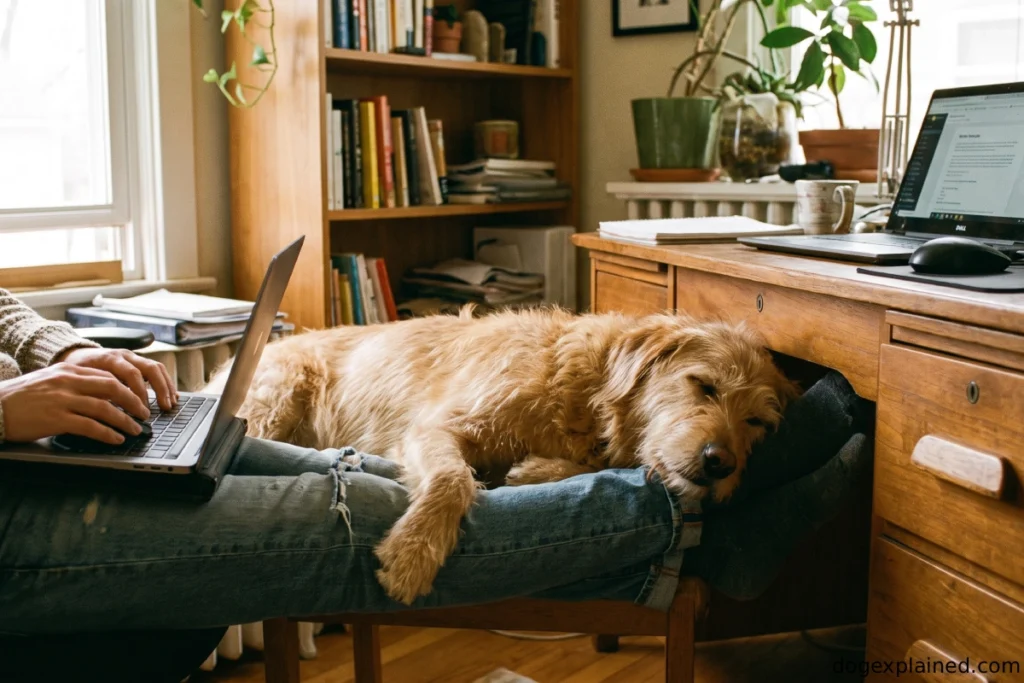
Signs that habit may be a big part of the behavior include:
- it happens in the same location
- it occurs around the same time each day
- your dog settles quickly
- they have done it for months or years
- nothing stressful is happening
- your dog can also relax elsewhere when needed
A familiar behavior doesn’t need fixing just because it looks unusual to us.
If your dog is comfortable and you don’t mind, their favorite foot-shaped mattress can remain part of the household routine.
5. Your Dog May Be Looking for Reassurance
Sometimes the context changes the meaning.
A dog that casually lies on your feet every evening is one situation.
A dog that normally rests independently but suddenly presses against your feet during fireworks is another.
Dogs can use familiar caregivers as a source of security. Research into dog-human attachment has found that owner presence can affect dogs differently from the presence of an unfamiliar person.
So extra proximity may be meaningful when your dog feels uncertain.
Situations that might trigger increased closeness include:
- thunderstorms
- fireworks
- unfamiliar visitors
- travel
- a new environment
- unusual household noises
- changes in routine
- another stressful event
But sitting on your feet alone does not diagnose anxiety.
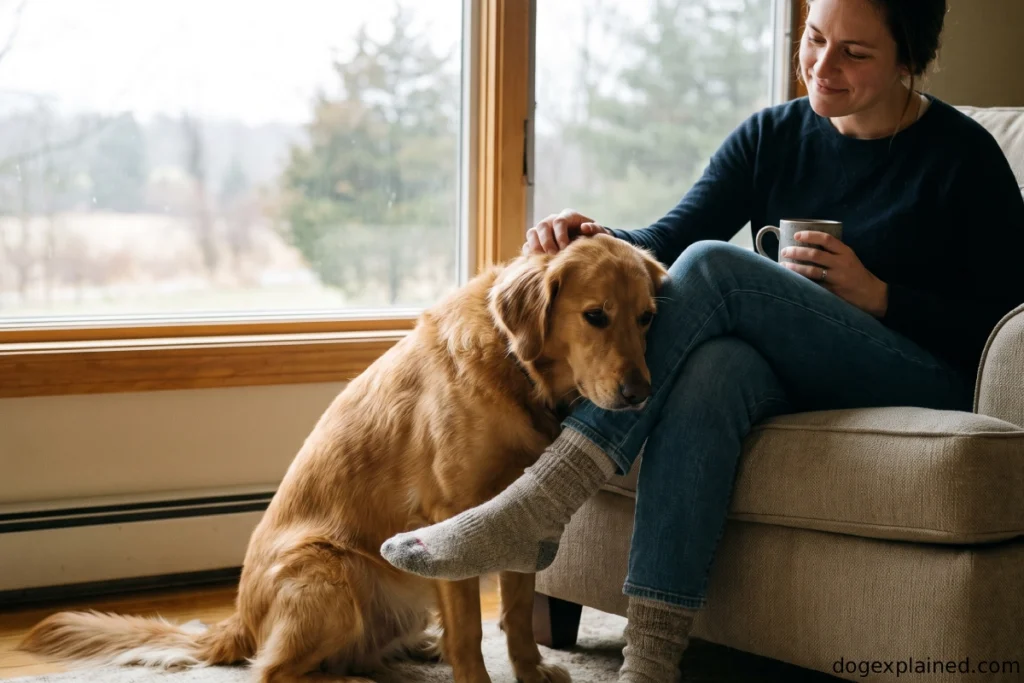
Look for other signs as well, such as:
- trembling
- panting when your dog isn’t hot
- pacing
- whining
- repeated lip licking
- difficulty settling
- unusually persistent attempts to stay close
- hiding or avoiding something
If the dog is completely relaxed and simply falls asleep on your feet, reassurance may not be the main explanation at all.
Context matters more than the position.
6. Your Dog Likes Physical Contact
Some dogs are simply more tactile than others.
One dog may prefer an entire sofa cushion to themselves.
Another wants some part of their body touching you at all times.
Dogs that enjoy physical contact may:
- lean against your legs
- rest their head on you
- lie across your feet
- sit partly on your shoes
- press against your side
- climb into your lap
There is no universal amount of physical contact that every dog should want.
Individual personality, experience, environment, learning history, and relationship with household members can all contribute.
This also means you shouldn’t judge the strength of your relationship based on whether your dog sits on your feet.
A dog can have a wonderful relationship with you and prefer sleeping across the room.
Another dog may follow you everywhere and use your feet as a pillow.
Both can be normal.
7. Your Dog Has Learned That This Is Their Spot
Sometimes the important part isn’t your feet.
It’s the location.
Suppose your dog’s bed used to sit beside your home-office chair.
The bed gets moved, but your dog keeps returning to the same area.
Now the thing occupying that familiar resting spot is your feet.
Or perhaps your dog discovered long ago that the safest place to settle without being disturbed is underneath your desk, exactly where your legs happen to be.
Dogs can develop strong location-based routines.
Your dog may therefore think:
“When my person is here, this is where I settle.”
If you want to change the habit, you don’t need to punish them.
Give them a clear alternative.
Place a comfortable mat or dog bed close enough that they can still be near you.
Then reward your dog for choosing it.
The goal is not to teach:
“Don’t be near me.”
It is to teach:
“This is an even better place to relax.”
Does Sitting on Your Feet Mean Your Dog Loves You?
It can certainly fit within an affectionate relationship.
If your dog voluntarily chooses to spend relaxed time physically close to you, that is meaningful.
Research supports the idea that dogs can form selective attachment relationships with familiar caregivers and may seek their proximity.
But science does not give us a dog-to-English dictionary where:
sitting on feet = “I love you.”
The behavior is better interpreted as one piece of a larger relationship.
Ask what your dog is like with you overall.
Do they approach comfortably?
Relax nearby?
Seek normal interaction?
Respond positively to you?
Choose your company?
Those patterns tell you much more than one resting position.
So you can enjoy the affection without pretending we know exactly what is going through your dog’s mind.
Is My Dog Being Dominant by Sitting on My Feet?
No—not based on this behavior alone.
The idea that ordinary dog behavior must be explained through dominance has led to a lot of unnecessary confusion.
Dogs do not climb onto your feet simply because they are plotting to move up the household hierarchy.
Veterinary behavior guidance cautions against using dominance theory as a general explanation for everyday behavior problems.
In many situations, a much simpler learning explanation exists.
If sitting on your feet repeatedly provides:
- attention
- petting
- comfort
- closeness
- warmth
- a familiar resting place
then those outcomes can help maintain the behavior.
There is no need to introduce a dominance story.
And there is certainly no reason to respond with “alpha” techniques, physical force, or attempts to prove that you are the boss.
If you don’t want your dog sitting there, teach another place to settle and make that option rewarding.
Is My Dog Protecting or Guarding Me?
Calmly sitting on your feet is not proof that your dog is protecting you.
This is another common internet interpretation:
“Your dog sits on your feet so they can guard you.”
Maybe an individual dog is attentive to the environment while close to their owner.
But the position by itself cannot tell us that.
Actual guarding behavior looks different.
Pay attention if your dog sits or lies on your feet and then reacts when someone approaches.
Potential warning signs include:
- suddenly becoming stiff
- freezing
- hard staring
- blocking someone from approaching
- growling
- showing teeth
- snapping
- lunging
Dogs can sometimes guard valued resources, and in some cases the companionship of a preferred person can become something the dog tries to control access to.
That should not be romanticized as:
“He’s just protecting me because he loves me.”
If your dog is relaxed when others approach, ordinary proximity is much more likely than a guarding problem.
If your dog becomes threatening or aggressive around access to you, manage the situation carefully and seek qualified behavioral help rather than deliberately testing the dog’s reaction.
Why Does My Dog Always Sit on My Feet?
If your dog does it every single day, ask what remains consistent.
Does it always happen when:
- you sit at your desk?
- you watch television?
- you eat dinner?
- you stop moving around the house?
- your dog wants petting?
Repeated behavior usually has a history.
It may keep happening because the location is comfortable, because it gives your dog contact with you, because it produces attention, or simply because it became part of the routine.
Try observing what happens immediately after your dog sits on your feet.
That information is often more useful than trying to guess what the position symbolizes.
Why Does My Dog Lay on My Feet Instead of Beside Me?
Some dogs seem to prefer direct contact rather than just proximity.
Lying beside you means being close.
Lying across your feet means being close AND touching you.
If your dog likes physical contact, that small difference may matter.
Your feet may also:
- provide something to lean against
- occupy the dog’s usual resting location
- be warmer than the floor
- place the dog directly beside your chair
- reliably lead to interaction
The behavior doesn’t automatically mean your dog is anxious or overly dependent.
If they lie down, relax, and sleep comfortably, it may simply be their preferred way of settling near you.
If your dog prefers sitting directly on you rather than your feet, see our guide to why dogs sit on their owners.
Why Does My Dog Sit on My Feet but Not Someone Else’s?
There are several possible explanations.
Your dog may have a different relationship or learning history with you.
Perhaps you:
- pet them more often when they do it
- spend more time in the location where they usually settle
- have the most predictable daily routine
- are the person they normally choose for close contact
- have unknowingly reinforced the behavior for years
Attachment research also suggests dogs can distinguish the security provided by their owner from that provided by an unfamiliar person.
But don’t automatically conclude:
“I’m definitely the dog’s favorite because they sit on my feet.”
That may be true in your household, but feet-sitting alone can’t prove it.
What If My Dog Suddenly Starts Laying on My Feet?
A dog becoming more physically close than usual does not automatically mean something is wrong.
First look for practical changes.
Has the weather become colder?
Did you move furniture?
Has the dog’s usual bed disappeared?
Are there visitors in the house?
Has the daily routine changed?
Is there construction or unusual noise outside?
Any of those things could change where your dog chooses to settle.
But a sudden behavior change becomes more important when it appears alongside other changes.
Contact your veterinarian if unusual clinginess occurs together with signs such as:
- persistent restlessness
- appetite changes
- vomiting or diarrhea
- signs of pain
- stiffness
- mobility changes
- unusual vocalization
- major sleep changes
- confusion or disorientation
- another significant change from your dog’s normal behavior
Sitting on your feet is not a diagnostic sign.
The broader change in behavior is what matters.
Should You Let Your Dog Sit on Your Feet?
Usually, yes—if both of you are comfortable and the situation is safe.
There is no behavioral rule saying dogs must never sit on their owners.
You may want to change the habit if:
- you find it uncomfortable
- you need to move frequently
- your dog creates a trip hazard
- an older or mobility-limited person could fall
- your dog becomes distressed when moved
- your dog guards the position from people or pets
- the behavior interferes with normal activities
If you want more space, teach an alternative resting position.
Put a bed or mat nearby and make that location worthwhile.
You can reward your dog for:
- stepping onto the mat
- lying down there
- remaining relaxed there
- choosing the spot voluntarily
This gives your dog a clear answer to:
“Where SHOULD I go?”
rather than only telling them where not to be.
What About a Dog That Sleeps at Your Feet?
Sleeping at your feet is related, but it isn’t exactly the same behavior as deliberately sitting or lying directly ON your feet.
A dog sleeping nearby may be choosing a resting position based on:
- proximity
- room layout
- habit
- comfort
- temperature
- their preferred sleeping location
Because sleeping at your feet has its own patterns and search intent, it deserves to be considered separately rather than assuming every dog near your feet has the same motivation.
Frequently Asked Questions
Why Does My Dog Always Sit on My Feet?
Your dog may enjoy physical contact, find the spot comfortable, have learned that it produces attention, or simply consider it part of their normal routine.
Look at when it happens and what usually happens immediately afterward.
Why Does My Dog Lie Directly Across My Feet?
Direct physical contact may be more comfortable or socially rewarding for your dog than resting nearby.
Your feet may also happen to occupy their usual resting location.
Is Sitting on My Feet a Sign of Anxiety?
Not on its own.
A dog seeking extra proximity during a stressful situation may be looking for reassurance, but anxiety should be evaluated from the full context and additional signs such as trembling, panting, pacing, whining, or difficulty settling.
Does My Dog Think They Own Me?
There is no good reason to interpret ordinary feet-sitting as your dog claiming ownership of you.
Comfort, proximity, reinforcement, and routine are much simpler explanations.
Is My Dog Guarding Me When They Sit on My Feet?
Not if they are simply relaxed.
Guarding becomes more concerning when the dog stiffens, growls, blocks, snaps, or otherwise reacts when another person or animal approaches.
Why Does My Dog Lay on My Feet While I Work?
Your desk may provide a predictable resting location close to you.
If your dog has repeatedly relaxed there while you work, the combination of routine, proximity, and convenience can make it their preferred spot.
Should I Stop My Dog From Sitting on My Feet?
Not unless the behavior is uncomfortable, unsafe, disruptive, associated with distress, or accompanied by guarding.
If you want the dog elsewhere, teach and reward a nearby alternative resting spot rather than punishing them.
The Bottom Line
If your dog lays or sits on your feet, the explanation is usually simpler than dominance, possession, or protection.
Your dog may want to be close, enjoy physical contact, like the location, have learned that it gets attention, or simply consider your feet part of their normal resting routine.
The key is context.
A relaxed dog falling asleep across your feet is very different from a dog trembling during a storm or growling when someone approaches you.
Instead of asking what sitting on your feet universally “means,” look at what your individual dog is doing before, during, and after the behavior.
If the habit is comfortable and harmless, you may not need to change anything at all.