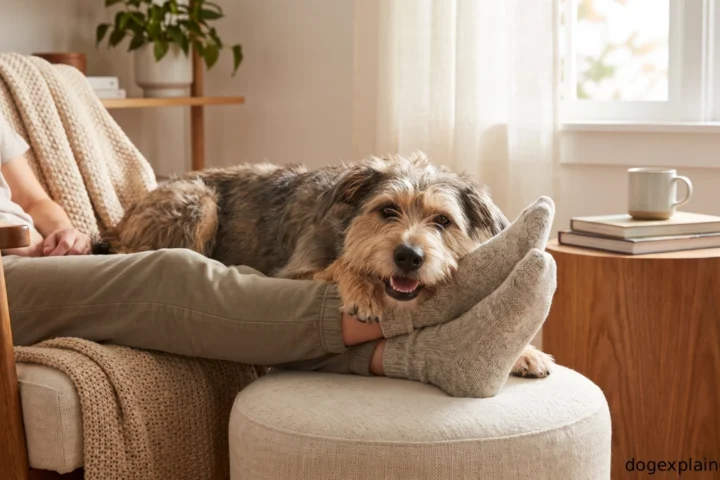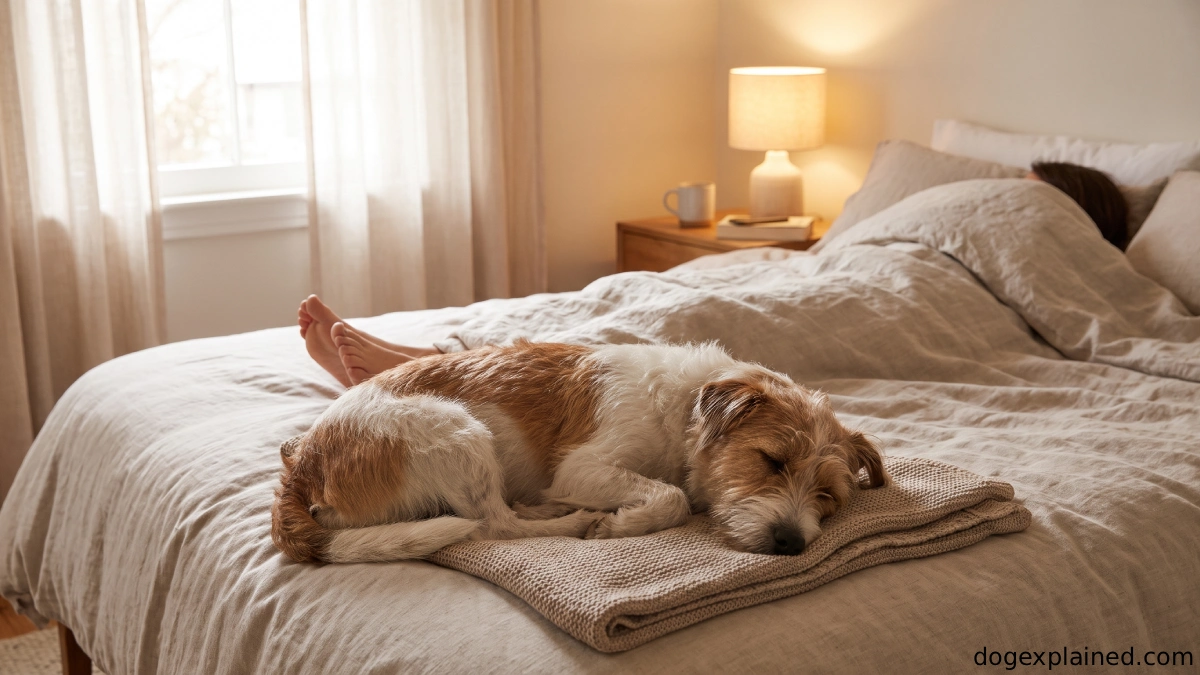
You get into bed, your dog circles around for a moment, and then settles in the same place they seem to choose every night: right by your feet.
Not beside your pillow.
Not in the empty space next to you.
Your feet.
Some dogs sleep at the foot of the bed, some curl up beside their owner’s legs, and others seem determined to use an actual foot as part of the mattress.
So why does your dog keep choosing that spot?
Usually, there isn’t one hidden message to decode.
Your dog may want to stay close to you without being crowded, prefer the temperature or space at the foot of the bed, have developed a familiar bedtime routine, or simply find that part of the sleeping area comfortable.
In some situations, sleeping near you may also provide reassurance.
What the position does not automatically prove is that your dog is protecting you, submitting to you, recognizing you as the “alpha,” or feeling anxious.
The most useful question is not just where your dog sleeps.
It is whether this is normal for your dog and what the rest of their behavior looks like.
Why Does My Dog Sleep at My Feet?
Dogs can be remarkably specific about where they sleep.
One dog wants the center of the human bed.
Another prefers the doorway.
Another sleeps in a dog bed across the room.
And another follows you to bed every night but settles only near your feet.
There are several behaviors here that sound similar but are slightly different.
A dog sleeping AT or BY your feet may simply want to rest nearby.
A dog sleeping directly ON your feet is choosing more physical contact.
And a dog that sits or lies on your feet while you are awake may be showing a broader proximity or resting behavior rather than a specific sleep preference.
Dogs are capable of forming meaningful attachment relationships with familiar caregivers. Research has found an owner-specific “secure base” effect in dogs, meaning the presence of their owner can affect how they behave in challenging situations.
That tells us that being near you can matter to your dog.
It does not tell us that the foot of your bed has one scientifically defined meaning.
Comfort, proximity, habit, temperature, and the physical layout of the sleeping space are all reasonable places to start.
1. Your Dog Wants to Stay Close to You
For many dogs, the simplest explanation is social proximity.
They want to sleep near you.
Not necessarily on top of you.
Not necessarily face-to-face.
Just nearby.
Research on dog-human attachment supports the idea that familiar owners can play a special role for dogs compared with unfamiliar people.
So a dog voluntarily choosing to spend hours sleeping close to you can fit naturally within a strong social relationship.
But there is an important distinction.
Research supports attachment and owner-directed proximity.
It does not establish:
“Sleeping at the owner’s feet specifically means trust.”
The location is only one small part of the behavior.
Look at the bigger picture.
Does your dog also:
- voluntarily spend time near you?
- relax comfortably around you?
- approach you willingly?
- seek you out in unfamiliar situations?
- sleep deeply rather than remaining tense?
- interact normally and comfortably with you while awake?
Those patterns tell you more about the relationship than which end of the bed your dog chooses.
Sometimes your dog simply wants the comfort of knowing you are there.
2. Your Dog Wants Closeness Without Being Crowded
Not every dog that enjoys your company wants to sleep pressed against your chest.
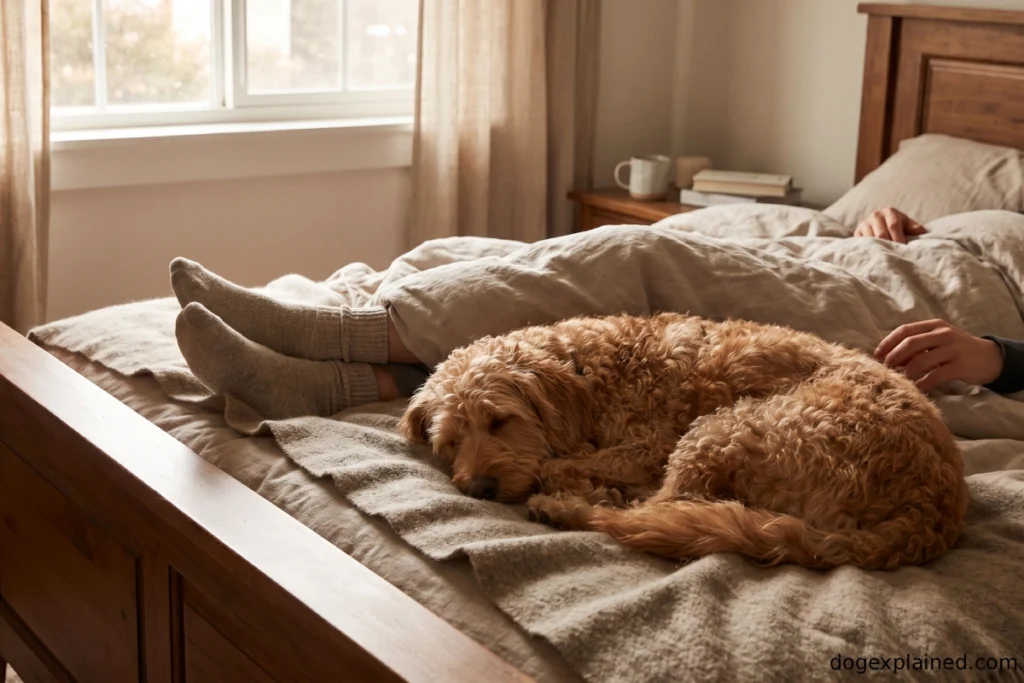
Dogs have individual preferences for physical contact.
Some love being under blankets.
Some want their head on your pillow.
Some prefer touching just one part of you.
And some seem happiest a few feet away.
Sleeping at your feet can offer a useful compromise:
your dog is close to you without being surrounded by your arms, pillows, blankets, and upper-body movement.
This may be especially appealing to dogs that enjoy proximity but don’t seek constant cuddling.
Think about how humans sleep.
You can feel perfectly comfortable and connected to someone without sleeping nose-to-nose all night.
Dogs can also prefer companionship without maximum contact.
If your dog settles quickly at your feet, has loose relaxed body language, and sleeps peacefully there, you may simply be looking at their preferred balance between closeness and personal space.
3. The Foot of the Bed Is Simply Comfortable
Sometimes the reason has more to do with the bed than with you.
The foot of a bed may offer:
- more open space
- fewer pillows
- less interference from moving arms
- easier access to the edge
- a familiar blanket
- a firmer section of mattress
- room to stretch out
- an easier path to get on and off
If your dog is larger, the bottom half of the bed may also be the only area where their body fits without being repeatedly moved.
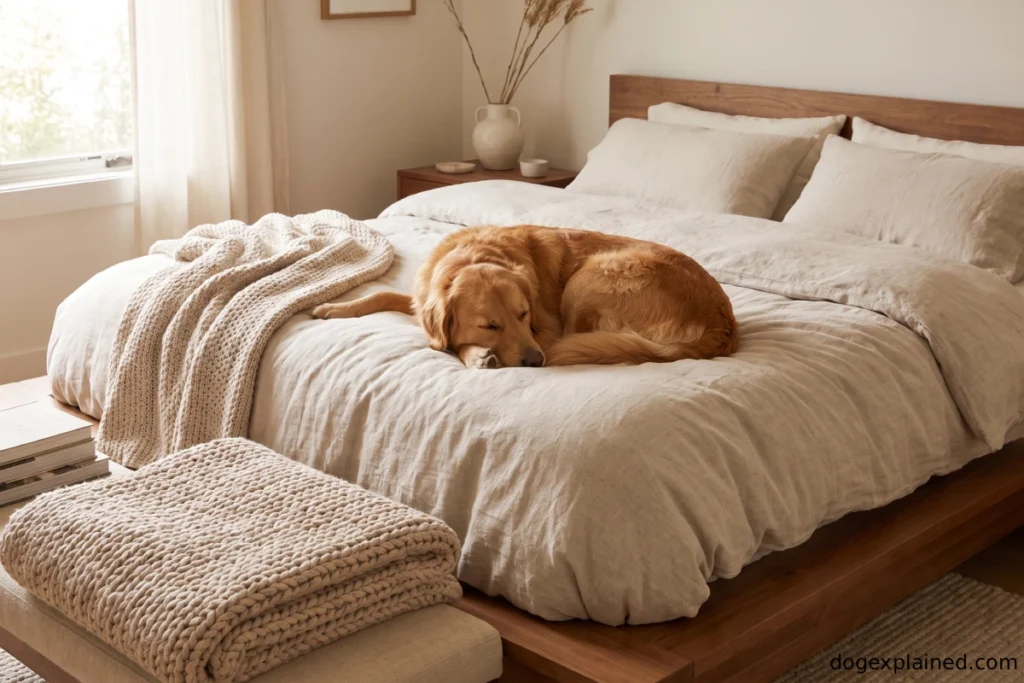
And if you turn over frequently, your dog may have learned that sleeping beside your upper body means being disturbed more often.
The foot of the bed may simply be quieter.
You can sometimes test this explanation without doing anything complicated.
Watch what your dog chooses when:
- nobody else is in the bed
- you move their favorite blanket
- the room temperature changes
- their normal sleeping area is blocked
- you sleep in a different room or bed
If the preferred location changes with the physical environment, comfort may be doing more of the explaining than social symbolism.
Sometimes a sleeping position says more about mattress logistics than canine psychology.
4. Temperature Can Influence Where Your Dog Sleeps
Dogs adjust their resting position in response to temperature.
You may already notice your dog:
- spreading out on cool tile in warm weather
- curling up tightly when the room is cooler
- moving closer to you for warmth
- leaving the bed when they become too warm
- choosing a spot near or away from airflow
The area around your feet can create a middle ground.
Your dog can stay near some body warmth without being pressed against your warmer torso.
Or, if the foot of the bed is closer to a fan, air-conditioning vent, or open space, that location may simply feel cooler.
A dog sleeping on the floor beside your feet may also prefer the cooler surface while still wanting to remain close.
This does not mean every feet-sleeping dog is regulating temperature.
It means temperature is one practical factor that can influence sleep position without requiring a deeper emotional explanation.
5. It Has Become Part of the Bedtime Routine
Dogs are excellent at learning routines.
You turn off the television.
You walk toward the bedroom.
Your dog follows.
You get into bed.
Your dog goes straight to the foot of it.
After hundreds of repetitions, this sequence may require very little thought from either of you.
Your dog may have learned:
“When we go to sleep, this is my spot.”
Long-standing sleeping locations can become familiar because they are:
- predictable
- comfortable
- undisturbed
- associated with rest
- repeatedly available
- part of the household routine
This explanation is especially likely when your dog:
- chooses the same location every night
- has done so for months or years
- settles immediately
- sleeps normally
- doesn’t seem distressed if you move around
- can sleep elsewhere when necessary
There is no need to assign a fresh emotional motive to the behavior every night.
Habit can be a perfectly good explanation.
6. Your Dog May Be Seeking Reassurance
Context can change the meaning of proximity.
A dog that has slept at your feet every night for five years is one situation.
A dog that normally sleeps alone but suddenly presses against your feet during a thunderstorm is another.
Dogs can use familiar caregivers as a source of security.
Research on dog-owner attachment has found owner-specific secure-base effects, and studies of dogs sleeping in an unfamiliar environment have also found associations between attachment to the owner and aspects of canine sleep physiology.
That does not mean sleeping at your feet is an anxiety symptom.
It means extra proximity may be more meaningful when the environment is stressful or unfamiliar.
Examples might include:
- thunderstorms
- fireworks
- travel
- a hotel or unfamiliar home
- visitors
- construction noise
- a new pet
- household changes
Look for other signs rather than relying on sleeping location alone.
A worried dog may also:
- pant when they are not hot
- tremble
- pace
- whine
- repeatedly change position
- struggle to settle
- stay unusually close
- react strongly to sounds
A dog that simply curls up and falls asleep peacefully at your feet is a very different picture.
7. The Room Layout May Put Your Dog There
Dogs don’t choose sleeping locations in an empty laboratory.
They choose them in real bedrooms full of furniture, walls, doors, blankets, people, and other pets.
The foot of your bed may happen to be:
- closest to the bedroom door
- easiest to access
- nearest the dog’s own bed
- the least crowded part of the mattress
- beside an open section of floor
- away from pillows and blankets
- the area where another pet doesn’t sleep
Some dogs may also prefer facing into the room rather than toward a wall.
That still doesn’t prove they are “guarding” you.
The sleeping position may simply give your dog a comfortable view of the environment or make it easier to get up.
When a physical explanation fits the situation, you don’t need to invent a pack hierarchy to explain it.
Does Sleeping at Your Feet Mean Your Dog Loves You?
It can certainly fit within a close relationship.
If your dog has the entire house available and repeatedly chooses to sleep near you, that proximity is worth noticing.
Dogs can form selective attachment relationships with their caregivers, and studies support the idea that owners can function as a unique source of security.
But we should stop short of translating one position directly into one emotion.
There is no scientific formula saying:
sleep at feet = love.
A more defensible interpretation is:
Your dog voluntarily chooses to rest close to you and appears comfortable doing so.
That can be consistent with a positive social bond.
Whether they choose your feet, your side, the couch beside you, or a dog bed in the same room is likely influenced by many other factors too.
Is My Dog Protecting Me While They Sleep?
You cannot tell that from sleeping location alone.
A common internet explanation says dogs sleep at their owner’s feet because they are:
- guarding the door
- protecting the owner
- keeping watch
- positioned to defend the “pack”
That sounds satisfying, but the sleeping position itself does not establish protective intent.
A dog might face the doorway simply because:
- that is the open side of the room
- their head fits there
- they prefer facing outward
- it is cooler
- it is easier to get up
Dogs can certainly show vigilant or protective behavior in other contexts.
But you would need broader evidence from the dog’s awake behavior before interpreting a sleeping position that way.
If your dog is sleeping deeply with loose muscles and relaxed breathing, there may not be much “guard duty” happening at all.
Is Sleeping at My Feet a Sign of Submission?
No reliable evidence supports using sleeping at your feet as a simple test of submission.
Older dog-training explanations sometimes interpret nearly every interaction through dominance hierarchies.
Sleeping lower on a bed, sleeping near someone’s feet, walking through doors, eating order, and many other everyday behaviors have all been given rank-based explanations over the years.
Modern veterinary behavior guidance cautions against broadly applying dominance theory to ordinary companion-dog behavior.
If your dog sleeps at your feet because the spot is:
- comfortable
- familiar
- close to you
- less crowded
- cooler
- part of the routine
there is no reason to replace those simple explanations with a story about social rank.
Your dog does not need to be demonstrating that you are “alpha” every time they fall asleep.
Why Does My Dog Sleep on My Feet?
Sleeping directly on your feet adds one obvious factor:
physical contact.
A dog that sleeps ON your feet rather than merely nearby may enjoy:
- direct body contact
- warmth
- something to lean against
- a familiar position
- being physically connected while resting
If your dog lies on your feet while awake as well as during sleep, the behavior may overlap with their broader preference for physical proximity.
If your dog also regularly sits or lies directly across your feet while you are working or relaxing, see our guide to why dogs lay or sit on their owner’s feet.
Sleeping on your feet still does not automatically indicate anxiety, guarding, dominance, or another specific motivation.
Look at context.
A relaxed sleeping dog is giving you different information from a dog that cannot settle unless they maintain constant contact.
Why Does My Dog Sleep by My Feet Instead of Next to Me?
Your dog may simply prefer a little more space.
Sleeping beside your upper body can mean dealing with:
- moving arms
- pillows
- blankets
- human breathing close to the face
- more frequent disturbance
By your feet, your dog can remain socially close without being crowded.
The location may also be more consistent night after night.
Your pillow moves.
Your arms move.
Your sleeping position changes.
The foot of the bed may stay relatively predictable.
For a dog that likes routine, that can matter.
Why Does My Dog Sleep at the Foot of My Bed?
The foot of the bed may offer a useful combination of:
- proximity
- personal space
- room to stretch
- easier access
- fewer disturbances
- comfortable temperature
- a familiar sleeping routine
You do not need to assume the dog is positioning themselves to “protect the entrance.”
If your dog chooses the location every night, sleeps comfortably, and behaves normally, it may simply be the part of the bed they prefer.
Why Does My Dog Always Sleep at My Feet?
When the behavior happens every night, routine becomes an especially strong explanation.
Ask yourself:
Has your dog always slept there?
Do they go there automatically at bedtime?
Is their blanket or favorite sleeping surface there?
Do they settle quickly?
Do they sleep deeply and comfortably?
If yes, the behavior may have become their established sleeping pattern.
Repeated behavior does not always mean repeated emotional decision-making.
Your dog may not be deciding each night:
“I must sleep at my person’s feet because of our relationship.”
They may simply be going to bed.
What If My Dog Suddenly Changes Where They Sleep?
A change in sleeping location by itself usually isn’t enough to tell you something is wrong.
Dogs change sleeping spots for ordinary reasons.
For example:
- the weather gets warmer
- furniture moves
- a new blanket appears
- another pet occupies the old spot
- the dog discovers a cooler floor
- household routines change
What matters more is whether the sleeping-location change is part of a broader change in your dog’s behavior or comfort.
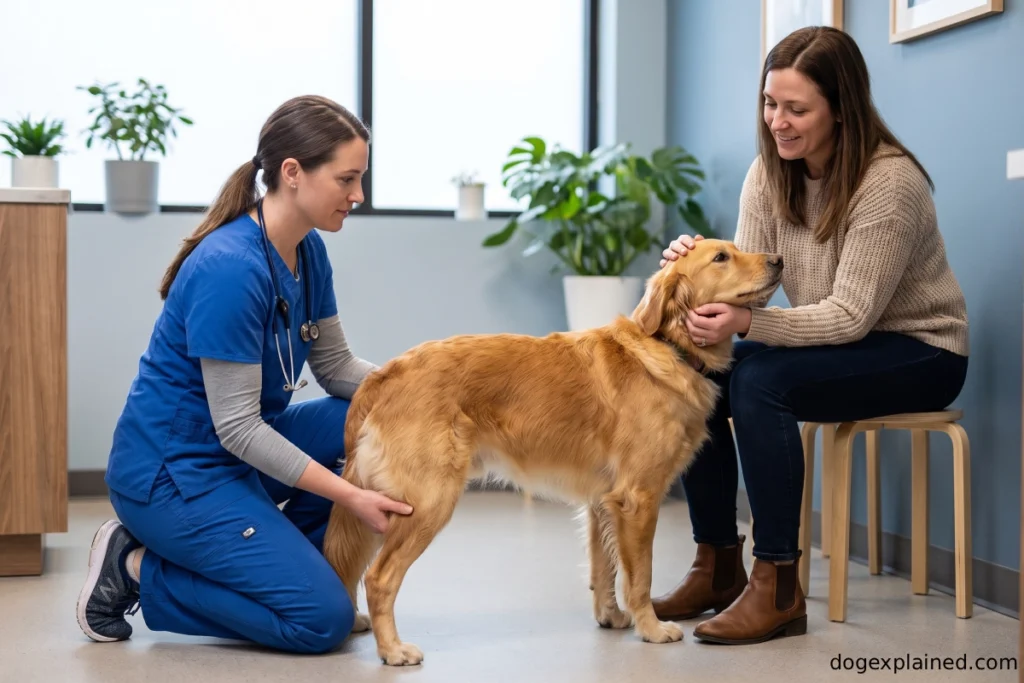
Pain can alter how dogs rest and sleep.
Pay more attention if your dog also:
- repeatedly gets up and lies down
- seems unable to get comfortable
- paces at night
- appears stiff
- limps
- has difficulty standing
- avoids stairs or jumping
- whines or groans when settling
- sleeps much more or less than usual
- becomes unusually needy or withdrawn
- pants excessively at rest
- loses interest in food
Those signs are more informative than whether your dog moved from your feet to another side of the room.
If your dog suddenly changes sleeping habits and also seems painful, unwell, confused, or unable to settle, contact your veterinarian.
When Should You Talk to a Vet?
You usually don’t need a veterinary appointment simply because your dog likes sleeping at your feet.
Consider contacting your veterinarian when a new sleeping pattern appears alongside:
- persistent restlessness
- pain or stiffness
- limping
- mobility changes
- difficulty getting comfortable
- major appetite changes
- unusual lethargy
- excessive panting at rest
- confusion or disorientation
- significant personality changes
- another noticeable departure from normal behavior
Seek prompt veterinary care if your dog is having difficulty breathing or otherwise appears acutely unwell.
The important idea is simple:
the sleeping location is rarely the diagnosis.
The other changes occurring with it are what matter.
Should You Let Your Dog Sleep at Your Feet?
Usually, yes—if everyone involved is comfortable and safe.
There is no behavioral rule saying dogs should never sleep on a human bed or near their owner.
You might prefer a different arrangement if:
- your dog repeatedly wakes you
- you have allergies
- the dog takes up too much space
- getting out of bed becomes difficult
- your dog creates a fall risk
- another pet is being displaced
- your dog growls or guards the sleeping area
If you want your dog to sleep elsewhere, give them an attractive alternative.
A comfortable dog bed can be placed:
- beside your bed
- at the foot of the bed
- in another preferred area of the room
Reward your dog for settling there.
You do not need to use dominance techniques or punish your dog for wanting to sleep near you.
The goal is simply to teach a sleeping arrangement that works for everyone.
Frequently Asked Questions
Why Does My Dog Only Sleep at My Feet?
Your dog may have developed a strong preference for that particular sleeping location because it combines proximity, comfort, space, temperature, and routine.
If they sleep peacefully and can rest elsewhere when needed, there may be nothing concerning about the preference.
Why Does My Dog Sleep on My Feet?
Directly sleeping on your feet provides more physical contact than sleeping nearby.
Your dog may enjoy the warmth, pressure, closeness, or familiar position.
The behavior alone does not establish anxiety or protection.
Why Does My Dog Sleep by My Feet Instead of Beside Me?
Some dogs seem to prefer staying close without being crowded.
The foot of the bed can provide proximity while avoiding pillows, moving arms, and more intense body contact.
Does My Dog Sleep at My Feet to Protect Me?
You cannot determine protective intent from sleeping location alone.
A dog facing the room or doorway may simply find that orientation comfortable or convenient.
Look at the dog’s broader awake behavior rather than assuming the sleeping position is guarding.
Is Sleeping at My Feet Submissive Behavior?
There is no good reason to treat sleeping at someone’s feet as a reliable submission signal.
Comfort, proximity, temperature, habit, and room layout are much more practical starting explanations.
Why Does My Dog Sleep at the Foot of My Bed?
The foot of the bed may provide more space, less disturbance, easier access, a comfortable temperature, or simply the sleeping location your dog has learned to prefer.
Should I Worry If My Dog Suddenly Stops Sleeping Near Me?
Not from the location change alone.
Look for other changes such as pain, stiffness, restlessness, appetite changes, unusual sleep patterns, or changes in normal behavior.
If your dog otherwise seems healthy and relaxed, they may simply have discovered another comfortable place to sleep.
The Bottom Line
If your dog sleeps at your feet, there usually isn’t a secret message you need to decode.
Your dog may want to stay close without being crowded, prefer the temperature or space there, enjoy some physical contact, or simply regard that location as their normal bedtime spot.
Being near you can be consistent with a meaningful dog-human bond.
But sleeping at your feet does not automatically prove protection, submission, dominance, anxiety, or any other single emotion.
Look at the whole dog.
If your dog has always slept there, settles comfortably, and behaves normally, you probably don’t need to change anything.
If their sleeping habits suddenly change alongside pain, restlessness, mobility problems, appetite changes, confusion, difficulty breathing, or another significant change from normal, speak with your veterinarian.