
You rinse a few strawberries, your dog is waiting nearby, and one berry rolls onto the floor before you have removed the green top.
Or maybe your dog grabs the leafy part from the counter before you can stop them.
So, can dogs eat strawberry tops?
The short answer is that ordinary strawberry tops, leaves, and stems are not considered toxic to dogs. But that does not mean they are the best part of the fruit to feed.
The green top is tougher and harder to digest than the soft strawberry flesh, and eating enough leaves or stems may contribute to digestive upset.
For that reason, the better approach is simple: wash strawberries, remove the green top and stem, and serve only the prepared fruit in appropriately sized pieces.
Can Dogs Eat Strawberry Tops?
It is better not to intentionally feed strawberry tops to dogs.
When people say “strawberry top,” they usually mean the green leafy cap, the short stem attached to it, and sometimes a small amount of fruit that comes off when the berry is hulled.
The good news is that ordinary strawberry plants are not classified as toxic to dogs.
That means the concern is not the same as it would be with a poisonous plant or toxic food.
The reason to remove the top is more practical.
The green leaves and stem are:
- tougher than the fruit,
- harder to digest,
- unnecessary as a treat, and
- more likely to cause digestive upset than the soft berry itself.
If you are already preparing strawberries for your dog, there is little reason to leave the tougher green parts attached.
Are Strawberry Tops Toxic to Dogs?
No. Ordinary strawberry tops are not considered toxic to dogs.
The ASPCA lists strawberry, or Fragaria species, as non-toxic to dogs.
This is an important distinction because online advice sometimes makes strawberry leaves and stems sound poisonous.
They are not generally classified that way.
But “non-toxic” does not automatically mean “recommended to eat.”
A dog can consume something that is not poisonous and still develop an upset stomach because the material is difficult to digest.
That is why veterinary and pet-health guidance commonly recommends removing strawberry leaves and stems before serving the fruit.
The better way to think about strawberry tops is:
Not poisonous, but unnecessary and less digestible than the fruit.
What Exactly Is the Strawberry Top?
The term “strawberry top” can mean slightly different things depending on how the berry is prepared.
Usually, it includes:
- the leafy green cap,
- the small attached stem, and
- sometimes a little of the upper fruit.
The soft red or pale fruit underneath the leaves is still part of the strawberry itself.
The main concern in this article is the green plant material rather than the edible berry flesh.
This advice also assumes that the plant really is an ordinary strawberry.
If your dog eats an unidentified plant or wild berry, do not assume it is safe simply because it resembles a strawberry.
Correct plant identification matters.
Can Dogs Eat Strawberry Leaves?
Strawberry leaves are not considered toxic to dogs, but they are not something you need to feed intentionally.
The leaves contain tougher plant material than the fruit and can be more difficult for a dog to digest.
A dog that eats one or two leaves may have no problem at all.
Another dog may develop:
- loose stool,
- diarrhea,
- vomiting,
- reduced appetite, or
- mild stomach discomfort.
The amount eaten and the individual dog’s digestive tolerance both matter.
The simplest approach is to remove the leaves before giving strawberries as a treat.
Can Dogs Eat Strawberry Stems?
It is also better to remove strawberry stems.
The short green stem attached to the fruit is not considered poisonous, but it is tougher than strawberry flesh and provides no practical benefit as a dog treat.
If your dog accidentally eats a small stem, that does not automatically mean there is an emergency.
But when you are preparing strawberries intentionally, removing the stem takes only a moment and makes the fruit easier to eat.
Veterinary and pet-nutrition guidance commonly recommends removing both stems and leaves before serving strawberries to dogs.
Why Remove Strawberry Leaves and Stems If They Aren’t Toxic?
It may seem unnecessary to remove something that is not poisonous.
There are still several good reasons to do it.
1. They Are Harder to Digest
Strawberry flesh is soft.
The leaves and stem are tougher plant material.
Dogs can eat many plant-based ingredients, but that does not mean every fibrous plant part is equally easy to digest.
A tougher texture may increase the chance of digestive discomfort in some dogs.
2. They May Cause Stomach Upset
Eating leaves or stems can contribute to digestive signs such as:
- vomiting,
- diarrhea,
- loose stool, or
- reduced appetite.
These signs do not mean the dog has been poisoned.
They are more likely to reflect gastrointestinal irritation or difficulty digesting unfamiliar plant material.
3. They Add No Real Benefit
The fruit is the part normally offered as a treat.
The green top does not need to be included for your dog to enjoy the strawberry.
If removing a part of the food makes it easier to digest without taking away the useful part of the treat, removing it is the more sensible choice.
My Dog Ate Strawberry Tops — What Should I Do?
If your dog has already eaten strawberry tops, the first step is to work out approximately what happened.

There is a big difference between accidentally swallowing one leafy top and eating a bowl full of discarded strawberry stems and leaves.
Step 1: Estimate How Much Was Eaten
Ask yourself:
- Was it one top?
- Several tops?
- A large pile of leaves and stems?
- Did your dog also eat whole strawberries?
- Did the material come from a garden plant?
- Are you certain the plant was a strawberry?
You do not need an exact weight.
A reasonable estimate is enough if you need to contact your veterinarian.
Step 2: Remove the Remaining Material
Move any remaining strawberry tops, leaves, stems, compost, or food waste out of reach.
This prevents a small accidental ingestion from becoming a much larger one.
Step 3: Observe Your Dog
Watch your dog for changes such as:
- vomiting,
- diarrhea,
- reduced appetite,
- unusual lethargy,
- abdominal discomfort, or
- other behavior that seems noticeably different from normal.
A dog that eats one strawberry top and continues behaving normally is a different situation from a dog that eats a large quantity and develops repeated vomiting.
Step 4: Contact Your Veterinarian if Needed
Contact your veterinarian if:
- your dog ate a large amount,
- vomiting is repeated or persistent,
- diarrhea is severe or persistent,
- your dog becomes weak or unusually lethargic,
- your dog seems painful,
- your dog stops eating,
- you are not sure what plant was eaten, or
- you are concerned for another reason.
The goal is not to panic over a strawberry leaf.
It is to respond appropriately if the ingestion or symptoms are significant.
What If My Dog Ate One Strawberry Top?
If a healthy dog accidentally eats one ordinary strawberry top and remains completely normal, poisoning is not expected.
That is because ordinary strawberry plant material is not classified as toxic to dogs.
You can:
- remove any remaining tops,
- make sure your dog cannot eat more, and
- observe for digestive upset.
If your dog develops vomiting, diarrhea, reduced appetite, weakness, or another concerning change, contact your veterinarian.
You do not need to assume a medical emergency simply because one green strawberry top was swallowed.
What If My Dog Ate a Lot of Strawberry Leaves or Stems?
A larger amount of tough plant material is more likely to cause digestive upset than a single leaf or stem.
If your dog eats a substantial quantity, pay closer attention to:
- vomiting,
- diarrhea,
- loss of appetite,
- stomach discomfort,
- unusual tiredness, or
- weakness.
Contact your veterinarian if you are concerned about the amount eaten or if symptoms develop.
It is especially important to ask for professional advice if the dog is very small, young, has a known gastrointestinal condition, or the plant identity is uncertain.
Garden Strawberries vs Store-Bought Strawberries
The basic strawberry advice is similar whether the fruit comes from the grocery store or your garden, but garden strawberries add a few practical considerations.
Store-Bought Strawberries
Before feeding:
- wash them thoroughly,
- remove the green top and stem,
- cut them into appropriately sized pieces.
Washing helps remove dirt and any surface residue from handling, transport, or agricultural treatments.
Garden Strawberries
If your dog has access to a strawberry patch, make sure the plant has been correctly identified.
Also consider whether the area has recently been treated with:
- pesticides,
- herbicides,
- fertilizers, or
- other garden chemicals.
The strawberry plant itself may be non-toxic, but another substance on the plant could create a separate problem.
If you know your dog ate recently treated garden material, contact your veterinarian or the product manufacturer for advice about that specific exposure.
How Should You Prepare Strawberries for Dogs?
Preparation is simple.
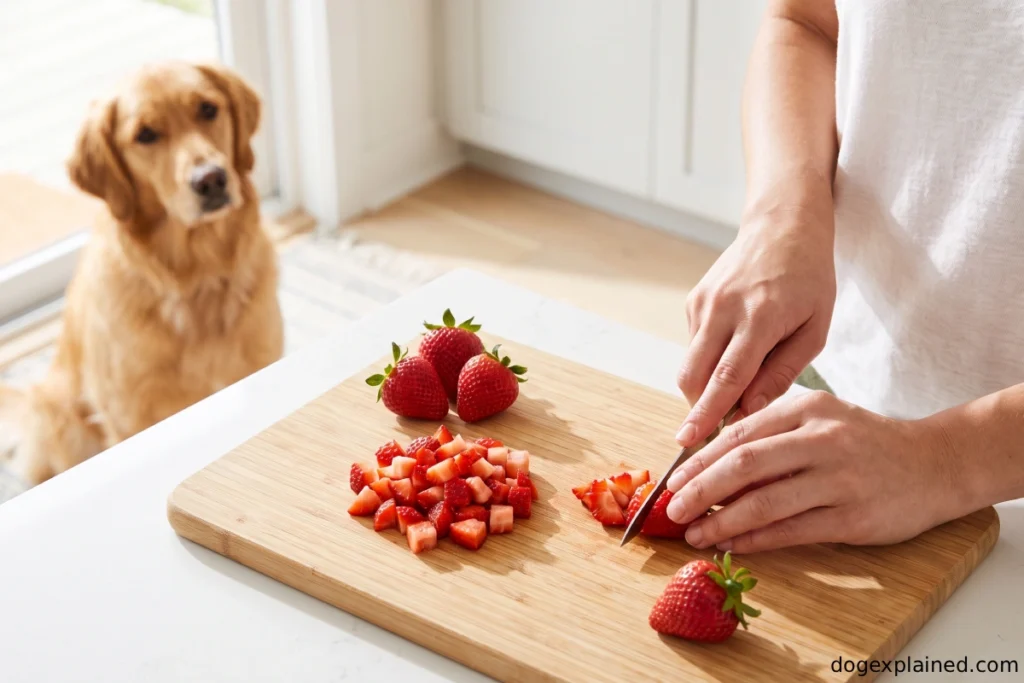
1. Wash the Strawberries
Rinse the fruit thoroughly under clean water.
2. Remove the Green Top
Take off the leaves and attached stem.
3. Cut the Fruit Into Appropriate Pieces
Cutting helps reduce choking risk and makes the fruit easier to eat.
The appropriate size depends on your dog.
A small dog will need smaller pieces than a large dog.
4. Feed Strawberries as a Treat
Strawberries can be an occasional treat rather than a major part of the dog’s diet.
Even foods that are generally safe should not replace a balanced diet.
Can Dogs Eat Whole Strawberries?
Some dogs may be able to chew a whole strawberry safely, but cutting the fruit is a better option.
A whole strawberry can be difficult to manage for:
- small dogs,
- puppies,
- dogs that gulp food quickly, or
- dogs that do not chew treats thoroughly.
Preparing the fruit in smaller pieces lowers the risk of choking and makes portion control easier.
Remove the green top first.
Can Puppies Eat Strawberry Tops?
Puppies should not intentionally be given strawberry tops.
The same reasons apply as with adult dogs:
- leaves and stems are tougher than the fruit,
- they offer no real benefit, and
- they may cause digestive upset.
If you choose to offer strawberry flesh to a puppy, remove the top and cut the fruit into appropriately sized pieces.
If a puppy eats a large amount of plant material or develops digestive symptoms, contact your veterinarian.
Strawberry Tops vs Strawberry Fruit
The difference is simple.
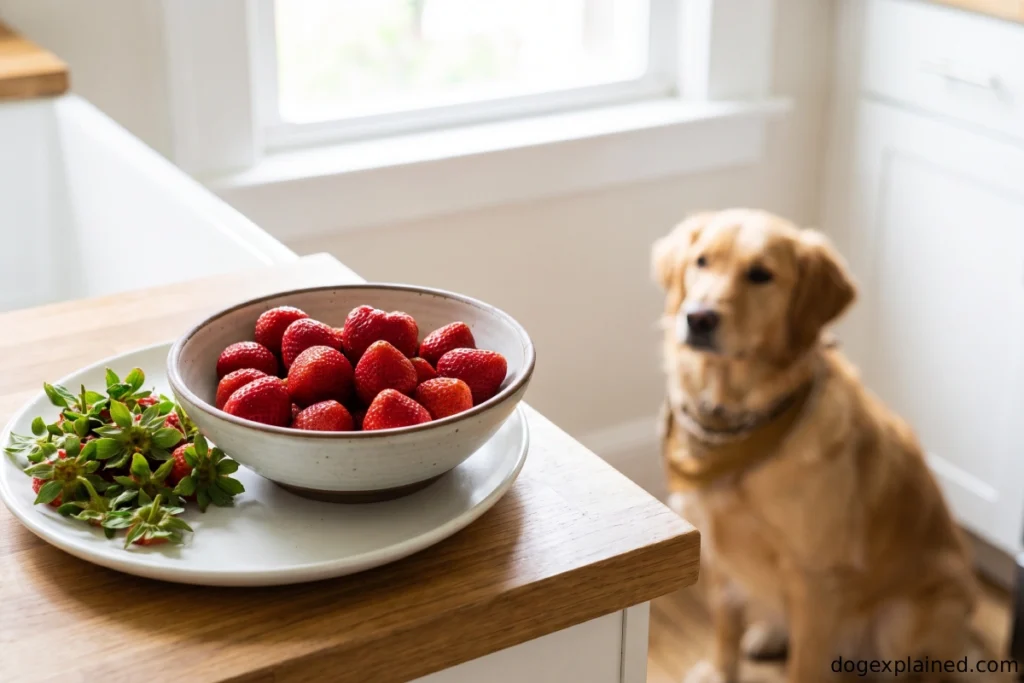
Strawberry Fruit
The fruit itself is generally considered non-toxic to dogs.
When prepared properly, it may be offered to many healthy dogs as an occasional treat.
Wash it, remove the green top, and cut it into manageable pieces.
If you want a broader guide to the fruit itself, see our article on can dogs eat strawberries.
Strawberry Tops
The green tops are also not considered toxic.
But they are:
- tougher,
- harder to digest,
- unnecessary, and
- more likely to cause digestive upset.
So the fruit and the top do not need to be treated as equally useful parts of the strawberry.
Are Strawberry Leaves Poisonous to Dogs?
No. Ordinary strawberry leaves are not classified as poisonous to dogs.
This is supported by ASPCA toxicology guidance for strawberry, or Fragaria species.
The better reason to remove strawberry leaves is not fear of poisoning.
It is because tougher leaves can be harder to digest and may upset some dogs’ stomachs.
This distinction matters.
Saying “strawberry leaves are poisonous” is inaccurate.
Saying “remove the leaves before feeding strawberries” is sensible.
Both safety and accuracy matter.
Can Dogs Eat Wild Strawberry Leaves?
Wild strawberry species in the Fragaria group are also generally listed as non-toxic.
But there is an important practical issue:
You need to know that the plant really is a strawberry.
Many plants and berries can look similar to someone who is not familiar with plant identification.
If your dog ate an unidentified wild plant, do not rely on strawberry-specific advice based only on appearance.
Take a clear photo of the plant if possible and contact your veterinarian or an animal poison-control service for guidance.
Should You Cut the Tops Off Strawberries for Dogs?
Yes.
Removing the top is an easy part of preparing strawberries for dogs.
A sensible preparation routine is:
- wash the fruit,
- remove the leaves,
- remove the stem,
- cut the strawberry into suitable pieces, and
- serve a reasonable amount.
There is little benefit to including the green material.
Can Dogs Eat the White Part Under the Strawberry Leaves?
Yes. The pale or white portion immediately under the green leaves is still part of the strawberry fruit.
You do not need to carve away a large section of edible fruit simply because it is lighter in color.
The main parts to remove are:
- green leaves, and
- the attached stem.
If a little edible strawberry flesh comes away with the top, that is simply a preparation choice rather than a safety requirement.
Frequently Asked Questions
Can dogs eat strawberry tops?
It is better not to intentionally feed strawberry tops. The leaves and stems are not considered toxic, but they are harder to digest and may cause stomach upset.
Are strawberry leaves toxic to dogs?
No. Ordinary strawberry leaves are not classified as toxic to dogs. They should still be removed before feeding because they may be harder to digest.
Can dogs eat strawberry stems?
It is better to remove the stem before serving strawberries. Small accidental ingestion is not generally considered poisoning, but stems are unnecessary and tougher than the fruit.
My dog ate one strawberry top. Should I worry?
If your dog ate one ordinary strawberry top and remains normal, poisoning is not expected. Monitor for digestive symptoms and contact your veterinarian if anything concerning develops.
Can strawberry leaves make a dog sick?
They can contribute to digestive upset in some dogs, particularly if a larger amount is eaten. Possible signs include vomiting, diarrhea, or reduced appetite.
Should I remove strawberry leaves before giving strawberries to my dog?
Yes. Wash the berry, remove the leafy top and stem, and cut the fruit into appropriately sized pieces.
Can puppies eat strawberry tops?
Do not intentionally feed strawberry tops to puppies. Remove the green material and offer only appropriately prepared fruit if strawberries are suitable for your puppy.
Can dogs eat the top of a strawberry?
The green top is not considered toxic, but it is better removed because it is tougher and harder to digest than the fruit.
Are strawberry stems poisonous?
No. Ordinary strawberry stems are not generally considered poisonous, but they are still not recommended as part of a dog treat.
The Bottom Line
Strawberry tops, leaves, and stems are not considered toxic to dogs.
That does not mean they need to be included when you give your dog strawberries.
The green parts are tougher and harder to digest than the fruit and may cause gastrointestinal upset, particularly if a dog eats a larger amount.
The safest routine is simple:
wash the strawberries, remove the leaves and stem, cut the fruit into suitable pieces, and feed the prepared berry rather than the green top.
If your dog accidentally eats one ordinary strawberry top and remains normal, poisoning is not expected.
If your dog eats a large amount, develops persistent vomiting or diarrhea, becomes weak, stops eating, appears uncomfortable, or you are not sure what plant was eaten, contact your veterinarian.
The most accurate way to describe strawberry tops is:
Not toxic, but still better removed before feeding.